
 Grade
Grade It’s all about energy – potential and kinetic, to be exact – as we create rockets in this lesson plan featuring a range of projects that are perfect for preschoolers to high school students! We’re also reading about real woman in STEM Katherine Johnson, whose mathematical calculations on rocket trajectory saved Apollo 13.
Resources in This Lesson
Resource 1
Learn all about the differences between potential and kinetic energy with this fun series of hands-on experiments!
Rosie Explores Potential and Kinetic Energy
https://handsonstem.rosieriveters.com/resources/rosie-explores-potential-vs-kinetic-energy/
Resource 2
NASA Mathematician Katherine Johnson was a master of rocket science. Read all about her in Counting on Katherine!
Rosie Reads Counting on Katherine
https://handsonstem.rosieriveters.com/resources/rosie-reads-counting-on-katherine/
Resource 3
Put all your knowledge of kinetic and potential energy from Rosie Explores to good use and build these awesome slingshot rockets!
Rosie Makes Slingshot Rockets
https://handsonstem.rosieriveters.com/resources/rosie-makes-slingshot-rockets/
Resource 4
Continue learning and exploring with some of these tried and tested Rosie Recommends activities from other STEM educational resources.
Rosie Recommends Rocket Activities!
https://handsonstem.rosieriveters.com/resources/rosie-recommends-rocket-activities/

Check out these tried and tested rocket-building activities from other STEM educational resources!
Recommended Resources
Resource 1
Our littlest friends ages two and up will love this rocket robot! Bonus: it’s super easy and affordable to do. The most important part is a battery-operated tooth brush from the dollar store!
Resource 2
Perfect for kids in elementary school, this rocket-building project shifts the focus from physics to chemistry. The rocket is propelled into the air via a chemical reaction!
Resource 3
Build a DIY version of the always-popular stomp rockets using air pressure and propulsion! This project requires a few non-household items (PVC elbows and pipes), but the payoff is worth it – “rockets” that propel into the sky via air pressure and the force of your feet!
Resource 4
Older kids will love making these hybrid rocket engines with yeast, pasta, and hydrogen peroxide! They’ll learn about chemical reactions and pure oxygen gas, and it’s just plain cool to think of pasta fueling a rocket! Note: this does require budding scientists to light the fuel source, so make sure you are in a clear area with adult supervision.
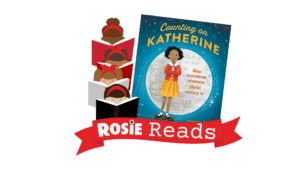
When you think about women in STEM and space, you definitely can’t ignore NASA mathematician and “hidden figure” Katherine Johnson! Counting on Katherine: How Katherine Johnson Saved Apollo 13 by Helaine Becker and illustrated by Dow Phumiruk chronicles Johnson’s story from her days as a childhood phenom (she skipped three grades!) to her remarkable mathematical calculations that saved Apollo 13.
When you’re finished reading Counting on Katherine, ask kids these comprehension questions:
- What challenges did Katherine face while she attended school?
- What was Katherine’s job at NASA? Describe it!
- How did Katherine save Apollo 13?
For our Rosie Reads activity, design your own rockets! Have kids think big and investigate the scientific factors (gravity, force, etc.) that determine how fast and far a rocket goes, and how it gets back to earth. With those factors in mind, have each child design a rocket and build it with materials you have hand (paper, cardboard, etc.)!
Watch The Video
https://youtu.be/6v8gXGZo51s
Items Available to Purchase
-
Rosie Reads about Real Women in STEM, set 1
$100
https://www.rosieriveters.com/shop#!/Rosie-Reads-about-Real-Women-in-STEM/p/123022665/category=53184730
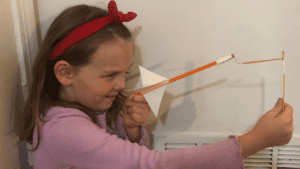
Blast off and explore potential and kinetic energy while making your own slingshot rubber-band rockets!
If you need a quick review, be sure to check out our Rosie Explores episode on potential and kinetic energy.
Ready to make this project at home or in your classroom? Watch the video for an overview, gather the materials listed at the right, and follow the instructions below!
Watch The Video
https://youtu.be/VTtjmwHUxDk
Required Materials
- rubber band
- popsicle stick
- masking tape
- straw
- paper clip
- card stock
- eraser
Step-By-Step Instructions
Step 1
Wrap the rubber band around the popsicle stick and secure it in place with masking tape.
Step 2
Slot the eraser (a small one from the end of a pencil) into the end of the straw and secure it with masking tape. Note: you may need to cut slits in the straw to ensure a secure fit.
Step 3
Bend the center of the paper clip out so that it is flat. The remaining hooked end should be bent at a 90 degree angle from the straight portion of the paper clip.
Step 4
Secure the flat end of the paper clip to the straw using masking tape. Keep the hooked end perpendicular to the straw.
Step 5
Fold a piece of card stock into four equal squares. Cut the corners off at an angle to create four equally-sized triangles.
Step 6
Secure each triangle to the base of the straw using masking tape. The base of the straw should now resemble a rocket.
Step 7
Loop the rubber band on to the hook of the paper clip. Push the popsicle stick away from you and pull the straw towards you.
Step 8
Release the straw and watch your rocket soar! Can you increase the distance traveled by increasing the distance the rubber band is pulled back? Be sure to identify the rocket’s potential energy and when/how kinetic energy occurs (link to the Rosie Explores video above if you need a review)!

Energy is the potential for something to do work, and we’re exploring the differences between potential and kinetic energy!
Potential energy is the energy stored in an object due to its position while kinetic energy is the energy an object possesses due to motion. We’re doing two experiments – one with a rubber band, the other with a balloon – to investigate!
Want to duplicate them at home or in your classroom? Watch the video for an overview, gather the materials listed at the right, and follow the instructions below!
Watch The Video
https://youtu.be/UOzDlPXzQWw
Required Materials
- balloon
- ruler
- rubber band
Step-By-Step Instructions
Step 1
To explore potential energy, hold a ruler so that the side marked with inches is facing away from you. Stretch a rubber band over the corner of the ruler to the one-inch mark. Make sure there is no one around you that you could accidentally hit with the rubber band, then release the rubber band. Next, measure how far the rubber band traveled.
Repeat steps one through four, this time stretching the rubber band back to the four-inch mark. Remember to make sure no one is around you! Note how much farther this rubber band went compared to the first time as it had more potential energy given its position further back along the ruler!
Step 2
To explore kinetic energy, blow up a balloon. Don’t tie it! Instead, let it go so it can fly! When filled with air, the balloon has potential energy – the stretched rubber of the balloon itself and the air inside it. When the air is released, the potential energy is converted to kinetic energy as the balloon deflates and zooms around the room!