Grown Up Guides – B
 Grade
Grade The mantra we repeat in our programs is “I may not know, but I know I can figure it out.” Our projects are designed to foster the same “we can do it” attitude, and we encourage you to share this message with your children at home.
K-2nd Grade Projects
Resource 1
Volcanoes
We encourage you to further explore the principles discussed in today’s project with your child in an effort to reinforce their understanding of the subject matter and inspire their continued curiosity of STEM. Below are some key terms and definitions we covered today regarding chemical reactions.
Physical Change: In a physical change there can be a difference in the appearance, smell, or simple display of a sample of matter without a change in composition.
Chemical Change: In a chemical change a new substance is formed and energy is either given off or absorbed.
Chemical Reaction: Don’t be alarmed if your kids start waving their hands around when you ask them what a chemical reaction is. We used our hands to remember that a chemical reaction is when we mix two different things together to make something new.
A fun example of a chemical reaction is when you mix vinegar and baking soda in your child’s model volcano, creating a fizzing eruption. This reaction produces bubbles of CO2 gas because the acidic vinegar reacts with the basic baking soda. If your child would like to erupt their volcano at home again all you need is a tsp of baking soda and some vinegar. You can add food coloring and glitter as well.
Check out our Rosie Explores activity below to learn more!
Rosie Explores Chemical and Physical Change
https://handsonstem.rosieriveters.com/resources/rosie-explores-chemical-and-physical-change/
Resource 2
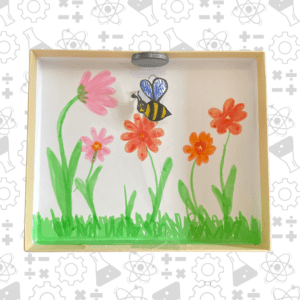
Flying Magnetic Art
Today we explored magnets by experimenting with what would and would not stick to a variety of different objects. We discovered that magnets are attracted to special metals (typically metals with iron in them).
Your child’s flying magnetic art project includes a metal paper clip (a magnetic object) that is attracted (pulled toward) the magnet at the top of their box. Because the magnet’s field is bigger than the magnet itself, we were able to put the paperclip on the outer edge of the magnet’s magnetic field (using the fishing line)so that the paperclip looks like it is flying!
Check out our Rosie Explores activity below to learn more!
Rosie Explores Magnetism
https://handsonstem.rosieriveters.com/resources/rosie-explores-magnetism/
Resource 3
Static Electric Dancers
We first examined static electricity by exploring atoms. Atoms are made up of three types of particles called protons (+), neutrons and electrons (-). By playing with magnets we were able to relate how these particles interact with each other. (+,+ or -,-) repel each other (push away) and opposite particles (+,-) attract each other (come together).
We then discussed places where we have seen or felt static electricity like if you’ve ever gotten a “shock” while walking or running in your socks or watched someone’s hair fly up in the air when it’s rubbed against a balloon! The rubbing between those two objects (eg. socks & floor or hair & balloon) causes some of the electrons in an atom to break away. But Atom’s like to be balanced. So if an electron is floating free in the world it will look for a proton to ATTRACT to!
We used this powerful attraction between protons and electrons to make our tissue paper creations dance and fly!
Check out our Rosie Explores activity below to learn more!
Rosie Explores Static Electricity
https://handsonstem.rosieriveters.com/resources/static-electricity/
Resource 4
Pom Pom Propulsion
Today we explored how forces, like propulsion, can be used to engineer a pom pom propeller that sends pom poms flying across the room!
Propulsion is a force that pushes or drives an object forward. When an object is pushed both forwards and upwards at the same time, we have what is known as a propulsion system. A great example of something that uses a propulsion system is an airplane! The jets of an airplane produce a gas known as exhaust which, when forced out the back of the plane by the engine, propels (pushes) the airplane forward.
Some questions to ask your kids include:
- What is propelling the pom poms out of the paper tube?
- How can they make the pom poms travel a shorter or longer distance?
Check out our Rosie Explores activity below to learn more!
Rosie Explores Propulsion
https://handsonstem.rosieriveters.com/resources/propulsion/

This fun experiment will allow you to explore magnets in a safe, hands-on setting!
Magnets are special pieces of metal that attract and repel other metals, specifically those with iron in them. All magnets have two poles, North and South. Opposite poles attract to each other and like poles repel each other. Explore this phenomenon with your magnets!
Want to duplicate this experiment at home or in your classroom? Watch the video for an overview, gather the materials listed at the right, and follow the instructions below!
Watch The Video
https://www.youtube.com/watch?v=iVDe1fB70ks
Required Materials
- box
- 2 small magnets
- metal paper clip (uncoated)
- fishing line
- tape
- coloring supplies
Step-By-Step Instructions
Step 1
Prepare your box. If you’re using a gift box like the ones in the video, reinforce the corners with tape so they are sturdy.
Step 2
Color/decorate the inside of the box.
Step 3
Draw and cut out a small (slightly larger than the paperclip) “flying” object.
Step 4
Tie a piece of fishing line to one end of the paper clip.
Step 5
Tape the paper clip to the back of your small “flying” object.
Step 6
Attach one magnet to the top of the box and another to the inside of the box. You’re creating a sandwich with the magnets and the box.
Step 7
Tape the end of the fishing line (opposite side of the paper clip) to the bottom of the box. You’ll want the length of the line between the end that you tape and the one with the “flying” object to be less than the full length of the box. I.e., the flying object should not touch the magnet “sandwich,” but it should be relatively close.
Step 8
Pull the fishing line so that the paper clip is attracted to the magnet (within its magnetic field) but not touching the magnet.
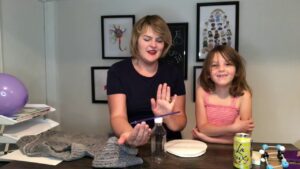
Explore the power of static electricity with these fun hands-on experiments.
Have you ever gotten a “shock” while walking or running in your socks or watched someone’s hair fly up in the air when it’s rubbed against a balloon? If you have you’ve seen static electricity in action! The rubbing between those two objects (eg. socks & floor or hair & balloon) causes some of the electrons in an atom to break away. But atoms like to be balanced. So if an electron is floating free in the world what will it work to do? Find a proton to ATTRACT to!
Want to duplicate this experiment at home or in your classroom? Watch the video for an overview, gather the materials listed at the right, and follow the instructions below!
Watch The Video
https://youtu.be/1e5QiLUuUsQ
Required Materials
- can
- straw
- plastic bottle
- balloon
Step-By-Step Instructions
Step 1
Blow up your balloon, and tie it off.
Step 2
Rub it on your shirt. It’s best if you use a wool material.
Step 3
Hold it over your head, and watch what happens to your hair! Note if you hear any sounds.
Step 4
Rub the plastic straw on your shirt. Then balance the straw on top of your bottle.
Step 5
Rub your hands on your shirt. Without touching the straw put your hands on opposite sides and opposite ends of the straw. Without touching the straw, watch what happens when you move your hands towards the straw!
Step 6
Rub the balloon on the wool shirt.
Step 7
Move the balloon towards the can, so that it is close to touching the can.
Step 8
Move the balloon away from the can, and watch what happens.

Join Rosie Girl Veronica as she uses a string, a balloon, and a straw to explore propulsion and Newton’s third law of motion – for every action there is an equal and opposite reaction!
Propulsion is a force that pushes or drives an object forward. Propulsion systems move objects up and forward at the same time. These systems make airplanes fly, and as Veronica shows in the video, rely on the principles of Newton’s third law!
Want to duplicate this experiment at home or in your classroom? Watch the video for an overview, gather the materials listed at the right, and follow the instructions below!
Watch The Video
https://youtu.be/LxFrSLKvc0k
Required Materials
- 1 balloon
- 1 straw
- tape
- string
- table
Step-By-Step Instructions
Step 1
Tape a balloon to the bottom of the straw. Make sure you can still blow air into the balloon – don’t tape around it!
Step 2
Tie one end of the string to a table leg or another stationary object.
Step 3
Thread the straw with the balloon attached through the untied end of the string.
Step 4
Tie the other end of the string to the opposite table leg (or other stationary object).
Step 5
Blow air into the balloon.
Step 6
Let go of the balloon and watch what happens! How does propulsion work? How does Newton’s third law of motion come into play?
Rosie Explores Chemical and Physical Change
- Fire is used as a part of these experiments. Please do not perform without an adult.
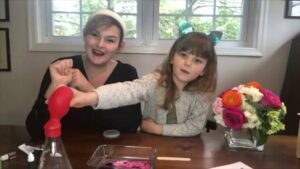
Learn the differences between chemical and physical change in this series of experiments. We’re playing with paper towels, blowing up balloons, and making all kinds of chemical reactions!
Watch The Video
https://youtu.be/7T9Edwh3dyE
Required Materials
- paper towel
- matches or lighter
- lemon (cut in half)
- glass cup
- baking soda
- food coloring
- popsicle stick
- Alka Seltzer tablet
- flask (or bottle)
- water
- 1 balloon
Step-By-Step Instructions
Step 1
Physical Change: In a physical change there can be a difference in the appearance, smell, or simple display of a sample of matter without a change in composition. To explore physical change, crumple up a piece of paper towel and observe that although the paper towel looks different, it is still a paper towel. We can reform it back into its previous state/shape and lay it flat.
Step 2
Chemical Change: In a chemical change a new substance is formed and energy is either given off or absorbed. To explore chemical change, we performed a number of experiments. First, with an adult present, crumple the paper towel back into a ball and use a lighter or match to light it on fire. Quickly drop it into a glass. Note what happens when the oxygen going into the fire is stopped by the glass. Is there a smell? Do you see smoke? After making your observations, be sure to put the fire completely out by pouring water into the glass. Use our fun hand trick from the video to remember that when chemical changes/reactions occur, you’ve mixed two things together to make something new! Another important thing to remember – you cannot reverse a chemical change, whereas you can reverse a physical change.
Step 3
We continued to explore chemical reactions with another experiment! Put half a lemon into a cup, so that the rind is facing downwards, and put a spoonful of baking soda on top of the lemon. Add a few drops of food coloring on top of the lemon and baking soda. Take a popsicle stick and push the baking soda down into the lemon. Note what happens when the citric acid from the lemon and baking soda mix and a chemical reaction takes place!
Step 4
For our last experiment, we used a chemical reaction to blow up a balloon! Break up an Alka Seltzer tablet and put the pieces inside a balloon. Fill up your flask or bottle about halfway with water. Then stretch the balloon with the Alka Seltzer pieces over the opening of the bottle (you’ll probably need to hold the Alka Seltzer pieces in the bottom of the balloon as you do this. It helps to have two sets of hands!). Drop the Alka Seltzer pieces from the balloon into the water. Shake up the bottle and note what happens to the balloon!