Grown Up Guides – C
 Grade
Grade The mantra we repeat in our programs is “I may not know, but I know I can figure it out.” Our projects are designed to foster the same “we can do it” attitude, and we encourage you to share this message with your children at home.
6th-8th Grade Projects
Resource 1
Wearable LEDs
An electric circuit is a closed loop of conductive material through which electricity can flow. It consists of a power source (e.g. a battery), a conductor (e.g. a wire), and a load (e.g. a light bulb). The electricity flows from the power source, through the conductor, to the load, and back to the power source, creating a complete circuit.
Today we created a sewable circuit scarf! The scarf lights up using a small battery and conductive thread, which they sewed into the design of the scarf. This project allowed participants to apply what they learned about circuits and conductivity in a hands-on, creative way.
It would be great for your children to share their new knowledge with you at home. To help with this, here are a few follow-up questions you can ask them:
- What is an electric circuit and what are its components?
- How does electricity flow through a circuit?
- What is conductivity and why is it important in electric circuits?
Check out our Rosie Explores activity below to learn more!
Private: Rosie Explores Electricity
https://handsonstem.rosieriveters.com/?post_type=rr_resource&p=1090
Resource 2
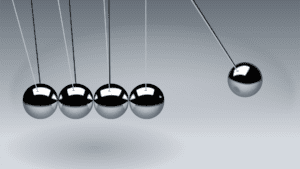
Newton’s Cradles
Today we explored Newton’s Laws of Motion. Newton’s Laws explain how objects move and interact with each other, and are fundamental to our understanding of physics.
We explored these laws in action by creating our very own Newton’s Cradle. This simple demonstration shows how the three laws of motion are at play. The Newton’s Cradle displays the laws by demonstrating the transfer of energy from one ball to the next, showing the First Law of Motion (an object at rest stays at rest unless acted upon by an unbalanced force), the Second Law of Motion (the acceleration of an object is directly proportional to the force applied and inversely proportional to the object’s mass), and the Third Law of Motion (for every force, there is an equal and opposite force).
We encourage you to ask your children about their experience building and using their Newton’s Cradle. Here are some follow-up questions that you can use to continue their learning at home:
-
- Can you describe the Third Law of Motion and how it applies to Newton’s Cradle?
- Can you think of any real-life examples that demonstrate these laws?
Check out our Rosie Explores activity below to learn more!
Rosie Explores Newton’s Laws
https://handsonstem.rosieriveters.com/resources/rosie-explores-newtons-laws/
Resource 3
Walking Robots
Today we explored balancing rotating objects and the importance of static vs dynamic balance.
Static balance refers to the stability of an object when it is at rest, while dynamic balance refers to the stability of an object when it is in motion. Balancing rotating objects is crucial to prevent vibration and potential failure in machines, and this is exactly what your children are experimenting with as they build their walking robots.
To continue your child’s learning at home, we encourage you to ask them the following questions:
- Can you explain the difference between static and dynamic balance?
- How do you ensure that your walking robot remains in balance while in motion?
- How does the weight distribution of the robot affect its balance?
- Can you give an example of how balancing rotating objects is important in real-world applications?
Resource 4
Hot Potato (coding)
We learned that a programming language is used to give very specific instructions to a machine, like a computer, so that it can complete a certain task. Many things around us in our daily lives contain computers and need to be programmed to function properly, including smart phones, washing machines and streetlights.
We used MakeCode for the Circuit Playground Express by adafruit – a great resource for STEM!
Resource 5
Marshmallow Sorters
Today we explore machine learning and its associated ethics. We explored these concepts with a marshmallow sorter project, where they used a tool called Teachable Machine to create a machine learning model that sorts items (in this case lucky charms cereal and marshmallows) into categories. This project gave them hands-on experience with the basics of machine learning and allowed them to consider ethical considerations in AI design.
To continue the conversation at home, we suggest asking your children the following questions:
- What is machine learning and how does it work?
- What ethical considerations should be taken into account in AI design?
- How do they think machine learning and AI will impact society in the future?
- What steps can be taken to ensure ethical use of AI?
Rosie Explores Newton’s Laws
- Make sure to wear your safety glasses!
This fun chemical reaction experiment explores Newton’s laws through equal and opposite reactions.
Want to duplicate this experiment at home or in your classroom? Watch the video for an overview, gather the materials listed at the right, and follow the instructions below!
Watch The Video
https://youtu.be/UQ1OFkK1c8M
Step-By-Step Instructions
Step 1
Take a balloon and blow it up.
Step 2
Let go of the ballon. Note which way the air goes and which way the balloon goes. This is an equal and opposite reaction.
Step 3
Next we are going to start another experiment. Put on your safety glasses.
Step 4
Fill the small container with water.
Step 5
Put the Alka Seltzer tablet in the container, close the container, and back away! Watch what happens!
Step 6
Repeat the process again. This time with two containers. Fill both containers with equal amounts of water. Drop an alka seltzer tablet in each one, and quickly put the containers together so that the lids are touching. Make sure to do this super fast!