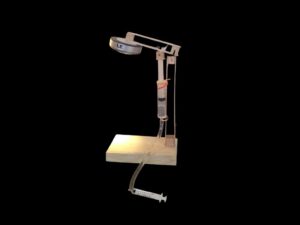
After School – Hydraulic Desk Lamp
- Our STEM projects are designed so that participants get it wrong before they get it right. You will observe your students struggling as they attempt to create their own STEM projects. This process is an empowering experience, building perseverance, frustration tolerance and growing overall confidence! With your support, students will step out of their comfort zones to think, build and problem-solve for themselves.
- The Hydraulic Desk Lamp Project aligns with 6.2, 6.4, 7.1, 7.5, PS.1, and PS.6, providing a hands-on exploration of hydraulics, fluid pressure, and mechanical advantage. Through this activity, students learn how hydraulic systems function, how force and pressure interact, and how these principles are applied in machines and devices used every day. The project encourages experimentation, engineering design, and a deeper understanding of how science and technology solve practical problems.
This guide is designed to introduce students to the principles of hydraulics, fluid pressure, and mechanical systems through a hands-on activity where they will build a hydraulic system that raises and lowers the arm of a desk lamp. The project aims to give students a deeper understanding of how hydraulic systems work, the concept of fluid pressure, and how these principles are applied in real-world machines and devices.
How This Guide is Structured:
- Teacher Script for Students:
- A ready-to-use script that explains the science behind hydraulics and the mechanics of fluid pressure. Feel free to read it directly to your students or adapt it to suit your teaching style.
- Key Concepts and Learning Goals:
- Students will learn how hydraulic systems use fluid pressure to transmit force, allowing small inputs to produce larger outputs. This principle is widely used in machinery, construction equipment, and even everyday items like car brakes.
- The project helps students understand mechanical advantage and the physics behind pressure, force, and area.
- Hands-On Experimentation:
- Students will build a simple hydraulic system using syringes, tubes, and water to control the arm of a desk lamp. By pushing and pulling the syringes, they will see how changes in fluid pressure can move the lamp arm up and down.
- Encourage students to experiment with different setups, varying the size of the syringes or the length of the lamp arm, to see how these changes affect the movement and control.
- Discussion and Reflection:
- Guide students through a discussion on how the hydraulic system works, the basics of fluid dynamics, and how hydraulics provide a mechanical advantage.
- Use reflection prompts to connect the concepts they observe to real-world machines and applications, such as hydraulic lifts, construction equipment, and braking systems.
- Wrap-Up and Real-World Connections:
- Conclude the session by discussing how hydraulic systems are used in everyday life and industries, from construction machinery to prosthetics and robotics. Highlight how understanding fluid pressure and hydraulics can lead to innovations in engineering and technology.
Teacher Script for Students
Today, we’re going to explore the fascinating world of hydraulics by building a desk lamp that you can control using a simple hydraulic system. But first, let’s talk about what hydraulics are and how they work.
What Are Hydraulics?
Hydraulics is the science of using liquids to transmit force. You might have seen hydraulic systems in action if you’ve ever watched a construction crane lift something heavy, or even when a car’s brakes are applied. These systems use fluid pressure to move or lift objects, and today, you’ll see how it works by building your own hydraulic desk lamp.
How Hydraulic Systems Work
In a hydraulic system, you use liquid (like water or oil) to transmit force from one point to another. When you push on a syringe filled with water, it forces the liquid through a tube to another syringe. Since liquids can’t be compressed, the force you apply on one end gets transferred to the other end, which causes the second syringe to move. This is how you can make the arm of your desk lamp raise or lower.
In your desk lamp, you’ll be using syringes, tubes, and water to create a basic hydraulic valve system. When you push on one syringe, the liquid moves through the tube to the other syringe, causing the lamp arm to move. This is the same principle behind big machines, like bulldozers or car jacks, but on a smaller scale.
Experimentation: Building and Controlling Your Lamp
Now that you understand the basics, it’s time to build! You’ll be connecting syringes to tubes filled with water and attaching them to your lamp arm. Try pushing the syringes in different ways to see how you can control the lamp. Want to make it move more smoothly or faster? Experiment with the amount of water in the system or the position of the syringes. This is your chance to learn by doing!
Mechanical Advantage and Fluid Pressure
One of the coolest things about hydraulics is that it can give you a mechanical advantage. That means you can use a small amount of force to lift something much heavier. This happens because of how fluid pressure works. When you push on a small syringe, it sends the same amount of force through the fluid to a larger syringe, which moves with more power. It’s like magic, but it’s actually just physics!
Wrap-Up and Real-World Connections
After we’ve built our hydraulic desk lamps, let’s talk about where we see these principles in the real world. Hydraulic systems are all around us:
- Construction Equipment: Cranes, bulldozers, and excavators use hydraulics to lift heavy loads.
- Automobiles: Car brakes and lifts rely on hydraulic pressure to work effectively.
- Prosthetics and Robotics: Hydraulic systems help power robotic arms and even medical devices that need precise control.
These systems are vital for industries all around the world, and by understanding how they work, you can see the incredible power of fluid pressure and mechanics. So, as you build and test your lamp, think about how small changes in pressure can create big movements, and imagine how engineers use these principles to solve real-world problems.
Let’s get started and see how you can control your own hydraulic desk lamp!
Careers and Role Models in STEM
Resource 1
Mechanical Engineer Mechanical engineers specialize in designing and building machines that use mechanical principles, such as hydraulics, to perform tasks. They work on a variety of systems, from car engines to heavy machinery, and even smaller devices like desk lamps with hydraulic systems. These engineers use their knowledge of fluid mechanics, thermodynamics, and materials science to develop efficient, safe, and reliable machines.
Resource 2
Dr. Ashwini Bharathula, Mechanical Engineer Dr. Ashwini Bharathula is a mechanical engineer who has worked extensively on fluid dynamics, a key component of hydraulic systems. She specializes in using hydraulic principles to design efficient cooling systems for electronics, as well as energy-efficient machinery. Dr. Bharathula’s research has helped improve the performance and sustainability of mechanical devices, including those that rely on hydraulics, showcasing how understanding fluid pressure can lead to innovative engineering solutions.
Check out some of her fun TED Educator classes here.