The mantra we repeat in our programs is “I may not know, but I know I can figure it out.” Our projects are designed to foster the same “we can do it” attitude, and we encourage you to share this message with your children at home.

3rd-5th Grade Projects

Resource 1

Bottle Rocket

Potential energy is the stored energy in an object due to its position or state, while kinetic energy is the energy of an object in motion. As we launched our rockets, we were able to see how the potential energy stored in compressed air converted into kinetic energy in the form of motion.

Here are a few questions that you can ask your child to continue their learning at home:

  • What is potential energy?
  • What is kinetic energy?
  • How did the compressed air in the bottle become kinetic energy?
  • Can you think of any other examples of potential and kinetic energy in our daily life?

Check out our Rosie Explores activity below to learn more!

Potential and Kinetic Energy Girl Blowing up a purple balloon

Rosie Explores Potential and Kinetic Energy

Investigate potential and kinetic energy with two fun experiments!

Resource 2

Pendulum Painting

Today we learned about how scientists proved the Earth rotates in 1851 by building a pendulum and we built our own pendulums in class today. 

Here is a question you can ask your child to continue their learning at home: How does a pendulum prove that the Earth rotates?

  • Answer: As the pendulum swings back and forth, Earth continues to rotate around it. Over time, the pendulum will appear to have shifted its place. We know the pendulum hasn’t moved, so we can be certain what’s moving is the planet around it.

Resource 3

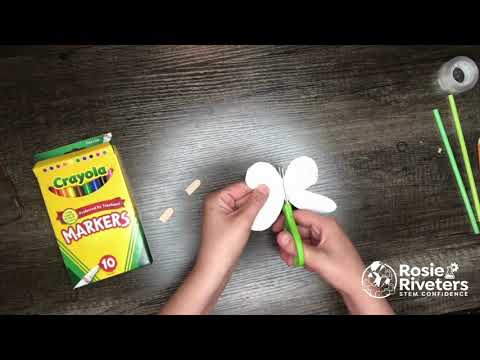
Blooming Flowers

Today we explored the different parts of a flower and the physics behind how flowers bloom.

As part of this learning experience, they created their own model of a blooming flower, which helped them understand the concepts in a hands-on and interactive way. They learned about the petals, stamens, pistil, and sepals, as well as the role of light, water, and nutrients in a flower’s growth.

To continue this learning at home, we have included a few questions below that you can ask your child about flowers. This will help reinforce what they learned in class and deepen their understanding of the subject.

  • 1. Can you name the different parts of a flower and explain what each part does?
  • 2. How do flowers use light, water, and nutrients to grow and bloom?

Resource 4

Green Houses

Today we explored the greenhouse effect.

The greenhouse effect is a natural process that helps keep the Earth warm by trapping heat in the atmosphere. We discussed how the increase of greenhouse gasses, such as carbon dioxide, in the atmosphere can lead to an increase in the Earth’s temperature.

To promote further exploration, you can ask your children the following questions:

  • What is the greenhouse effect and how does it work?
  • What are greenhouse gasses and why are they important?
  • What can we do to reduce our impact on the environment?

Resource 5

Solar System Wearables

Today we explored the order of the planets in our solar system and the distance between them. 

We learned a fun way to remember the order of the planets. You can ask your child if they remember the names of the eight planets in our Solar System in order and the sentence we learned to help us remember:  “My Very Excellent Mother Just Served Us Nachos”. We use the first letter of each word to help us remember the planets in order from the closest to the sun to the farthest from the sun: Mercury, Venus, Earth, Mars, Jupiter, Saturn, Uranus, and Neptune!

To continue the learning at home you can ask your child about the spacer beads between their planet beads and how the distance between them is scaled to represent the actual distance between the planets in our solar system!