 Grade
Grade  Print this resource
Big Idea: Breathing happens when changes in the space inside the chest create differences in air pressure. The diaphragm helps create these changes, allowing air to move into and out of the lungs.
Students build a model using balloons, straws, and a cup to investigate how movement of the diaphragm affects breathing.
Standards Snapshot: Virginia SOL + NGSS
The same project can support different levels of scientific thinking across grades 3–5.
| Grade | Virginia SOL | NGSS | Students work toward… |
|---|---|---|---|
| 3 | 3.1: Scientific and Engineering Practices · 3.4 as a broader connection to organism survival | Observing the model, describing what happens, and using observations to explain changes. | |
| 4 | 4.2: structures and processes that support survival (primary fit) · 4.1: Scientific and Engineering Practices | 4-LS1-1 (primary NGSS fit) | Using the model as evidence to explain how lung structures help humans survive. |
| 5 | 5.1: Scientific and Engineering Practices | 5-PS1-1 · 4-LS1-1 as a prior-grade connection | Investigating how volume changes move air, identifying model limitations, and supporting explanations with evidence. Balloons filling with invisible air is classic evidence that air is matter made of particles too small to see. |
| Looking ahead | Middle school life science | MS-LS1-3 | Arguing how body systems work together (breathing, blood, cells) builds directly on this model. |
Practices exercised: Developing and using models, making predictions, observing changes, constructing explanations, and communicating evidence.
Crosscutting concepts: Cause and Effect; Systems and System Models; Structure and Function.
Curiosity & Wonder
Ask students to place their hands gently on their stomachs and take a slow, comfortable breath.
“What changed when you breathed in? What changed when you breathed out?”
Let students share observations.
Then ask:
“Your lungs fill with air thousands of times every day. But what makes the air move in and out? Do your lungs pull the air in all by themselves?”
Invite predictions before explaining the diaphragm.
Introduce the project: “Today we’re building a model that helps us investigate what happens inside our bodies when we breathe.”
The Build
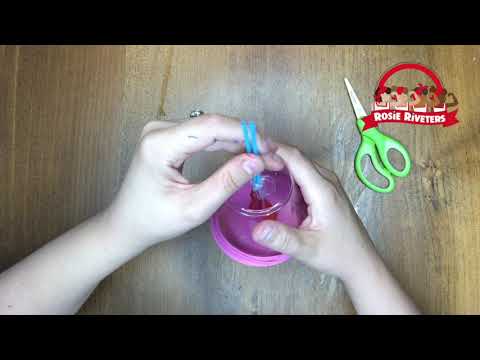
- Attach the lungs. Tape one small balloon to the end of each straw. Make sure the straw does not touch the bottom of the balloon.
- Add the lungs to the cup. Push both straws through the hole in the center of the cup. The balloons should hang inside the cup without sticking out. Tape the straws in place.
- Prepare the large balloon. Cut the narrow neck off the large balloon.
- Seal the cup. Stretch the large balloon tightly over the open end of the cup. Make sure there are no gaps around the edges.
- Test your lungs! Gently pull down on the large balloon. Watch what happens to the two small balloons inside the cup!
Facilitator note: The model depends on an effective seal. If the balloons do not respond, encourage students to inspect their construction before offering a solution.
Our STEM projects are designed so that participants get it wrong before they get it right. You will observe your students struggling as they attempt to create their own STEM projects. This process is an empowering experience, building perseverance, frustration tolerance, and growing overall confidence! With your support, students will step out of their comfort zones to think, build, and problem-solve for themselves.
Productive Struggle Moments
- Threading the straws: Getting both straws through the cup opening may require careful positioning and adjustment.
- Securing the air seal: Tape placement matters. If the balloons do not inflate, encourage students to investigate where air might be escaping.
- Stretching the large balloon: Cutting and stretching the balloon over the cup requires patience and careful handling. It may also require teamwork.
- The tape is different on purpose. The kit’s tape is not the clear tape most students are used to. We chose it deliberately: it does exactly what the build needs, but it may tear, stick, or stretch differently than students expect. Let them figure out how to work with it. Learning how an unfamiliar material behaves is real engineering, and engineers rarely get to pick the materials they wish they had.
When a model does not work immediately, ask: “What do you notice? Where could air be escaping? What could you change?”
The Investigation
Predict
Ask: “What do you think will happen to the small balloons when you pull the large balloon downward?”
Have students explain their predictions.
Test
Gently pull the large balloon downward and observe the small balloons.
Release it and observe again.
Repeat the movement and watch for changes.
Troubleshoot
If the balloons do not move as expected, investigate:
- Are the straws open?
- Are the balloons attached securely?
- Is air escaping around the cup opening or straws?
- What changes when you adjust the large balloon?
Encourage students to make one adjustment at a time and retest.
Explain the mechanism
- Grade 3: Pulling the large balloon down makes the small balloons expand. Releasing it allows them to shrink. The model demonstrates how movement helps air travel in and out.
- Grade 4: The large balloon represents the diaphragm. Moving it downward increases the space inside the cup and lowers the pressure relative to the outside air, allowing air to enter the small balloons. Releasing it reverses the process.
- Grade 5: Explain how changes in volume create pressure differences that move air. Evaluate what the model shows accurately and what it leaves out.
- Science note for teachers: In the human body, the diaphragm contracts and moves downward during inhalation, increasing chest cavity volume. During normal exhalation, it relaxes and moves upward. The cup model is a simplified representation: real lungs are not empty vacuum chambers, and the rib cage and other breathing muscles also contribute to respiration.
Skills in Practice
- “I predict the small balloons will ___ because ___.”
- “I observed ___ when I moved the large balloon.”
- “My evidence suggests that air moves ___ when ___.”
- “I changed ___, and the result was ___.”
- “One thing this model does not show is ___.”
Real-World Connection
Your respiratory system works continuously, whether you’re sleeping, walking, reading, or running.
Ask students:
“Why do you think you breathe faster after running?”
Connect their observations to the body’s need for oxygen and the removal of carbon dioxide.
Students can also consider why scientists and medical professionals use models to understand how body systems work.
Evidence of Learning
- Grade 3: Students demonstrate the model and describe what happens when the large balloon moves.
- Grade 4: Students explain how the diaphragm supports breathing and use evidence from the model to connect structure and function.
- Grade 5: Students explain the relationship between changing volume and air pressure, and identify at least one limitation of the model.
Vocabulary
- Diaphragm: A dome-shaped muscle beneath the lungs that helps move air in and out.
- Inhale: To breathe air into the lungs.
- Exhale: To breathe air out of the lungs.
- Air pressure: The force exerted by air on surrounding surfaces.
- Respiration: A biological process through which cells release energy from nutrients. Breathing supports respiration by bringing oxygen into the body and removing carbon dioxide.
- Model: A simplified representation used to understand or explain a system or process.
- Vacuum: A space containing little or no matter. A partial vacuum has lower pressure than its surroundings. Human lungs are not true vacuums.