 Grade
Grade  Print this resource
In this Rosie Labs guide you will find:
- Productive struggle opportunities for students during their project build,
- Lesson objectives and concept overview,
- Optional STEM topic video to share with participants,
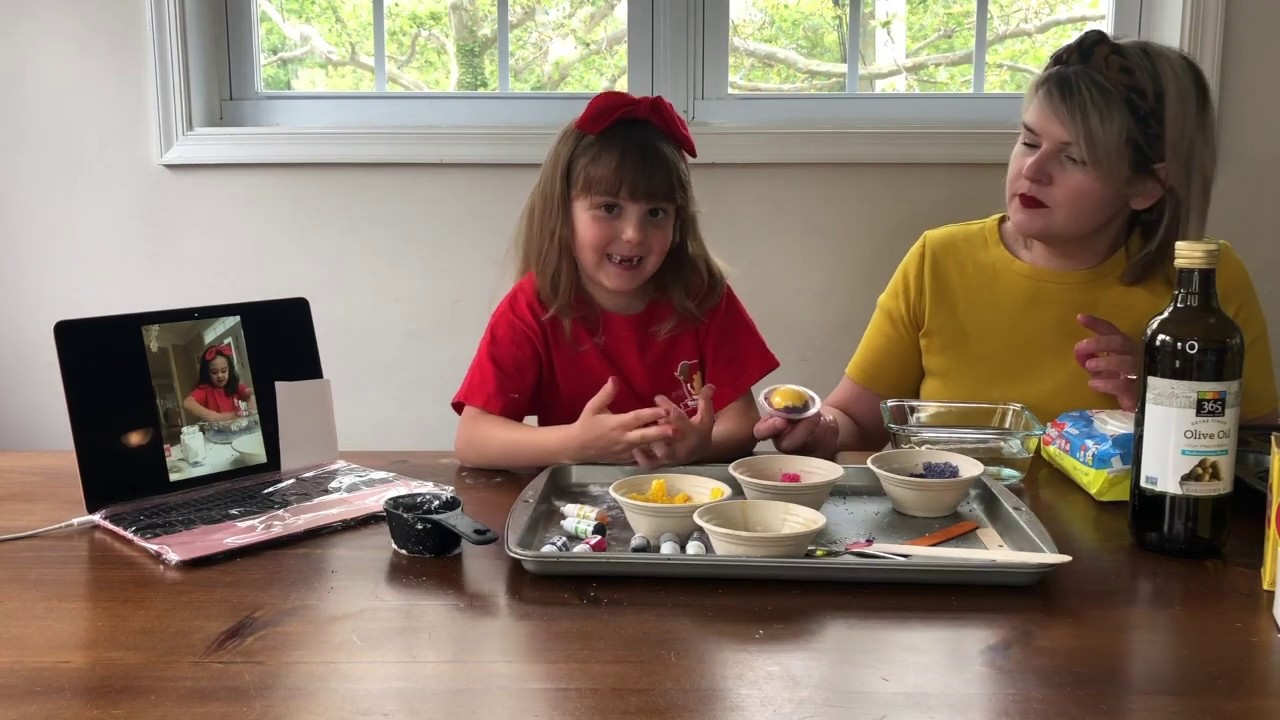
- Step-by-step instructions and video of the Rosie Riveters’ Bath Bomb Project,
- Optional STEM activities to further explore the objectives and concepts used in the project build.
Objective
Students will learn the differences between chemical and physical changes in matter while making bath bombs to take home!
Concept Overview and Experiment Inspiration
It may be surprising to find that chemical reactions are a part of daily life. Cooking, baking, rusting, and rotting are all forms of chemical reactions that we can see on a daily basis. A chemical reaction is a process a process that involves rearrangement of the molecular structure of a substance to turn it into something new. During this process, chemical bonds are broken and formed in order to create new molecules.
A chemical reaction can happen to anything. In fact, a reaction can occur between atoms, ions, molecules of a single element or compounds. The only important thing is that the result is a change in chemical identity (i.e. a new substance is formed). A common example of a chemical reaction is rust. When an object rusts iron (Fe) in the metal combines with oxygen (O2) in the atmosphere. Chemical bonds are created and destroyed, ultimately forming iron oxide (Fe2O3), a completely new substance. For comparison, a great example of a physical change is eating cereal in the morning.
This is different than a physical change where matter changes forms but not chemical identity. Some examples of physical changes are boiling, melting, freezing and shredding. A key difference between chemical and physical reactions is that physical reactions are technically reversible, whereas chemical reactions are not. When you take dry cheerios and place them into milk you get a physical change. The cheerios become soggy, but if you let them dry out, they will reverse back to their original state.
A more difficult but important example is the evaporation or freezing of water. While you may think that is a chemical change, it is actually a physical change because a new substance is not formed (i.e. it is still water), it is just in a different physical state (freezing into a solid or evaporating into a gas). However, the composition of the water has stayed the same.
Science Goals
- A Physical Change is when matter changes in the appearance, smell, or presentation without changing the kind of matter in the substance
- A Chemical Reaction is when a new kind of matter is created from combining reactants together
Vocabulary
Physical Change – when matter changes in the appearance, smell, or presentation without changing the kind of matter in the substance
Chemical Reaction – a process that involves rearrangement of the molecular structure of a substance
Reactant -a substance that takes part in and undergoes change during a reaction
Product– Something new that is made as a result of a chemical reaction