 Grade
Grade  Print this resource
Time: 30–45 min build + 5 min/day observation for one week (optional but recommended)
Big idea: A habitat must provide food, water, shelter, and space. Students build a feeder, make a prediction, and gather real evidence from their own schoolyard.
Pick your grade band. The build is the same; the thinking changes.
Standards Snapshot — Virginia SOL + NGSS
| Grade | Virginia SOL | NGSS | Students walk away able to… |
|---|---|---|---|
| K | K.7 — living things need food, water, air, shelter | K-LS1-1 · K-ESS3-1 | Use observations (the daily tally) to describe what animals need; use the feeder + habitat drawing as a model of where animals live and why. |
| 1 | 1.5 — animals have basic life needs and body parts/behaviors to meet them | 1-LS1-1 | Name the four needs; design a solution by mimicking animal parts (Bird Beaks extension is a direct hit). |
| 2 | 2.5 — living things are part of a system; habitats provide life needs | 2-LS4-1 | Compare living things in different spots (fence vs. trees, feeder vs. no feeder) using their own data. |
| 3 | 3.4 / 3.5 — physical and behavioral adaptations; ecosystem connections | 3-LS4-3 | Argue from evidence which birds thrived at the feeder and why (Friday data discussion). |
| 4 | 4.3 — organisms interact with living and nonliving parts of their ecosystem | 4-LS1-1 | Argue from evidence that birds’ structures (beaks, feet) support survival — observed live at the feeder. |
| K–5 | X.1 — Scientific & Engineering Practices | K-2/3-5-ETS1-1, ETS1-2 | Run a full mini design loop: choose a placement, predict, test, collect data, explain, revise. |
Practices exercised (both frameworks): asking questions and predicting; planning and carrying out investigations; analyzing and interpreting data; constructing explanations and arguing from evidence (3–5). NGSS Crosscutting Concept: Patterns (K–2), Cause and Effect (3–5).
Curiosity & Wonder
Don’t explain habitats yet. Wonder out loud with your students:
“I saw a bird outside this morning and I started wondering — where does it sleep? What did it have for breakfast? How could we find out?”
Let students guess. Write guesses down — these are their first predictions, and you’ll return to them.
Then name the four needs: every animal’s home has to give it food, water, shelter, and space. Today we’re helping with one of those. Which one? (Let them figure out it’s food.)
The Build
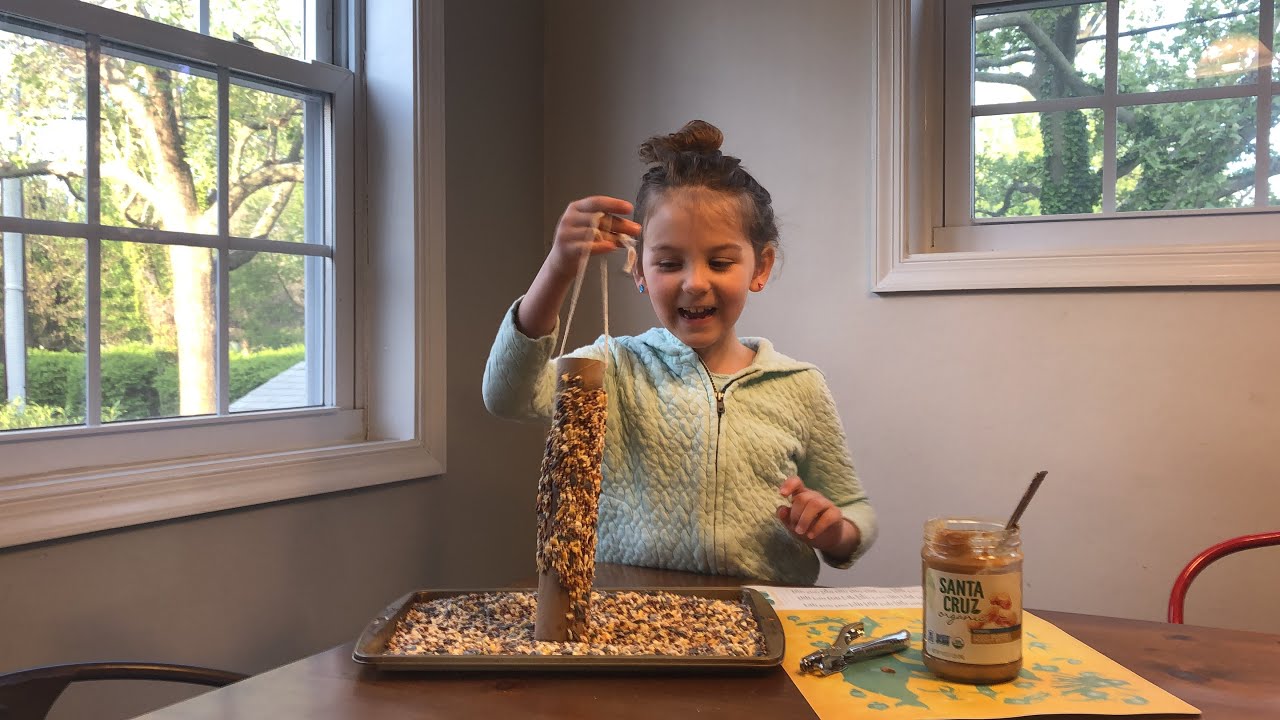
- Punch a hole on each side of the craft roll.
- Thread string through and tie a knot to make a handle.
- Spread the butter/shortening over the roll.
- Roll it in seed until covered.
Productive struggle moments
Our STEM projects are designed so that participants get it wrong before they get it right. You will observe your students struggling as they attempt to create their own STEM projects. This process is an empowering experience, building perseverance, frustration tolerance and growing overall confidence! With your support, students will step out of their comfort zones to think, build and problem-solve for themselves.
- Hole punch takes real hand strength. Let them try multiple grips.
- Threading string through a small hole is fiddly. Suggest they look at the problem from another angle before you touch it.
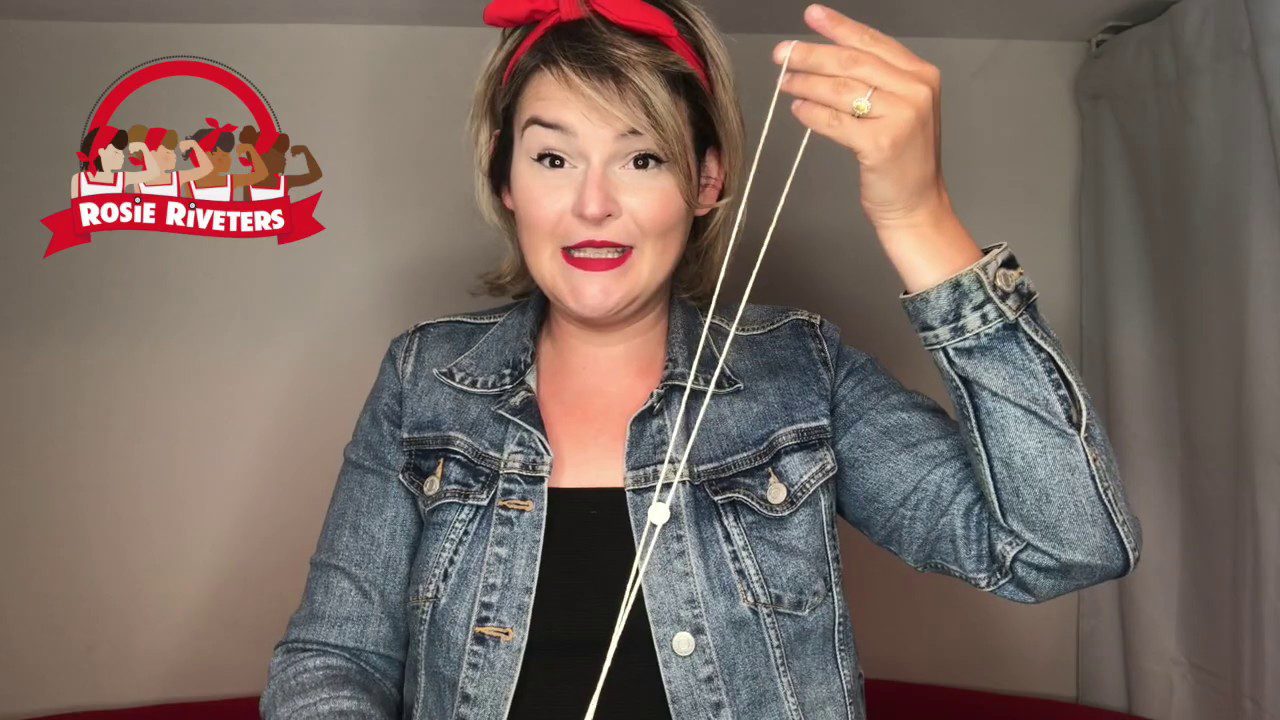
- Tying a secure knot may take three tries. Three tries is the point. If needed, please use the knot-tying guide to support the group in learning this skill. Knot Tying Guide
When a student gets frustrated, narrate instead of fixing: “You’re doing the hard part right now. What’s one thing you could try differently?” If the knot slips or the seed falls off, that’s not a failed feeder — ask, “What did that just teach you?”
The Investigation
Before hanging feeders, students make one real decision and one prediction:
Choose: Where should we hang it? (Near the fence? By the trees? High? Low?)
Predict: “I think ___ birds will visit because ___.”
Collect data — 5 minutes a day for a week:
- K–1: Class tally chart. Count birds together.
- 2: Small-group tallies; compare spots at the end of the week.
- 3–5: Individual data sheets — location, weather, number of birds, what the birds did. Graph results Friday.
Close the loop: Was your prediction right? What surprised you? If no birds came, that is data too; scientists learn as much from “no” as from “yes.” What would you change and try next?
Skills in Practice
Post these or use them verbally:
- “I predict ___ because ___.”
- “I observed ___.”
- “My evidence shows ___.”
- “Next time I would try ___ because ___.”
Real-World Connection
Birds are one of the few wild animals that thrive alongside people. They nest in buildings, drink from birdbaths, and visit feeders. But most wild animals need us to protect their habitats, not feed them.
Ask: “What’s one animal near your home, and what does its habitat give it?” (K–2: draw it. 3–5: label the four needs in the drawing.)
Evidence of Learning
- K: Student names the four things animals need, pointing to their feeder for “food.”
- 1–2: Student draws their feeder in a habitat and labels food, water, shelter, space.
- 3–5: Student writes 2–3 sentences using their data as evidence: “More birds visited the ___ feeder. I think this is because ___.”
Vocabulary
- habitat — the natural home of an animal or plant; it provides food, water, shelter, and space.
- adaptation (grades 3+) — a body part or behavior, developed over many generations, that helps an animal survive in its habitat. (Careful: individual animals don’t “decide to adapt” — populations change over long periods of time.)
- biome (grades 3+ extension only) — a large region of Earth with a similar climate, plants, and animals.