Print this resource
Time: 30–40 min build (plus ~15 min drying plan, a filler activity (options below))
Big idea: Marker ink looks like one color but is really a mixture. Students predict what colors are hiding inside, then use water and paper to find out.
Standards Snapshot — Virginia SOL + NGSS
Pick your grade band — the build is the same, the thinking changes.
| Grade | Virginia SOL | NGSS | Students walk away able to… |
|---|---|---|---|
| K | K.3 — physical properties of an object can be described (color) | — | Observe and name the colors that appear; show that blue + yellow make green by un-mixing a green marker (Color Theory Corner). |
| 1 | 1.3 — objects are made of materials with observable properties | — | Compare what happened with different markers using their own observations. |
| 2 | — | 2-PS1-1 · 2-PS1-2 | Classify results by observable properties; test which paper works best for the job (extension). |
| 3 | 3.3 — materials interact with water | — | Explain that water carried some colors farther than others; predict-test-explain. |
| 5 | 5.7 — matter has properties and interactions, including mixtures that can be separated | 5-PS1-1 | Explain that ink is a mixture of parts too small to see, and that chromatography separates it. |
| K–5 | X.1 — Scientific & Engineering Practices | K-2/3-5-ETS1-2 | Make a prediction, run the test, record results, and compare against the prediction. |
Practices exercised (both frameworks): asking questions and predicting · carrying out investigations · observing and recording data · constructing explanations from evidence. NGSS Crosscutting Concept: Patterns (K–2) · Scale — parts too small to see (5).
Curiosity & Wonder
Hold up a black marker. Don’t explain anything yet; wonder out loud with your students:
“This marker looks black to me. But I’ve heard a rumor that black ink is actually hiding other colors inside it. Do you believe that? What colors do you think are in there? How could we ever find out?”
Take guesses. Write them down. These are hypotheses, and the whole activity is a test of them.
The Build — With the Struggle Left In
Materials per student: 1–2 coffee filters, washable markers (black and brown separate best), pipette, cup of water, newspaper, black pipe cleaner.
- Predict first. Each student picks a marker and records (draws or writes) what colors they think are hiding inside it.
- Draw a circle around the center of the coffee filter, where the ridges meet the flat middle.
- Fill the pipette: squeeze the bulb, dip the tip in water, release. Drop water slowly into the center of the filter until it’s really wet.
- Watch what happens. As the water climbs the paper, the ink separates. Have students name the colors they see and compare to their predictions.
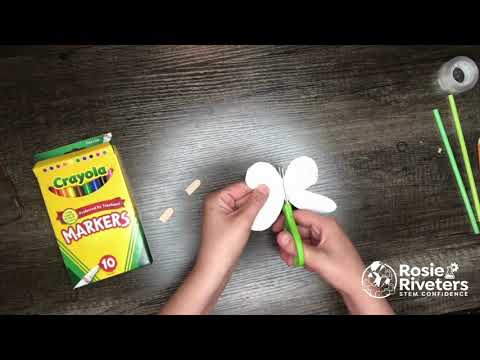
- Once dry, scrunch the filter in the middle and wrap a pipe cleaner around it, ends bent into antennae.
Productive struggle moments
Our STEM projects are designed so that participants get it wrong before they get it right. You will observe your students struggling as they attempt to create their own STEM projects. This process is an empowering experience that builds perseverance, frustration tolerance, and overall confidence! With your support, students will step out of their comfort zones to think, build, and problem-solve on their own.
- Drawing on fragile filter paper without tearing takes a light touch. If it rips, ask: “What will you do differently on filter number two?” (Ripped filters still fly — every butterfly is data.)
- The pipette takes coordination: squeeze before dipping, release while submerged. Let them figure out the sequence through trial. A puddle is not a disaster; it’s practice.
When frustration shows up, narrate instead of fixing: “You’re doing the hard part right now. What’s one thing you could change?”
The Investigation
The build becomes science with three moves:
Predict: “I think this marker is hiding ___ inside.” Compare: Give tables different markers (black, brown, purple, green). Whose separated into the most colors? Did two different black markers separate the same way? Explain the mechanism (grade-band it):
- K–1: The water gave the colors a ride. Some colors rode farther than others.
- 2–3: Ink is a mixture of colors. Water climbing the paper carries the colors along. The ones that dissolve easily travel far; the ones that grip the paper stay close.
- 5: Ink is made of particles too small to see. Chromatography separates the mixture because each pigment dissolves in water and sticks to paper differently. Scientists use this exact technique to identify unknown substances.
Great “failure” to plant on purpose: slip one permanent marker into the supply. It won’t separate; permanent ink doesn’t dissolve in water. That’s not a broken experiment; that’s a discovery. “Why do you think this one didn’t work? What does that tell us about this ink?”
Logistics: washable markers only for the main build (permanent markers are the planted “failure,” not the default). Cover tables. This one travels. Filters need ~15 minutes to dry; run the Which Paper Wins extension or the prediction discussion while you wait.
Color Theory Corner (Kindergarten and Grade 1)
For kindergarten and grade 1 students, chromatography is a magic trick that proves color mixing by running it backward.
Set it up (5 min, before the build) — use the markers already in the kit: On a scrap of coffee filter or white paper, color a patch of yellow marker, then color blue right on top of it in front of the class. Green appears. Then ask: “We just made green. But is the blue still in there? Is the yellow? Or did they disappear forever?” Take votes.
Prove it with the butterflies: Give kindergarten and grade 1 students green markers for their filter. As the water spreads, green un-mixes back into blue and yellow streaks. The colors were hiding in there all along!
“We mixed blue and yellow to make green — and chromatography un-mixed it to show us the recipe.”
Works with: green (blue + yellow), purple (blue + red/pink), orange (yellow + red). Won’t work with: most primary-color markers; they’re usually just one dye, and that’s a discovery too: “Yellow didn’t split. What might that tell us about yellow?”
Standards tie-in: K.4 (color as an observable property) plus a genuine mixture concept planted early. This is the same idea students will formalize in grade 5 (5.4, mixtures can be separated). Bonus: it doubles as an art-integration moment.
Skills in Practice
- “I predict this marker is hiding ___ because ___.”
- “I observed the colors ___.”
- “My evidence shows black ink is really ___.”
- “Next time I would test ___ because ___.”
Real-World Connection
Chromatography isn’t just butterflies. Forensic scientists use chromatography to match ink from a note to a specific pen, food scientists use it to check dyes in candy, and chemists use it to find out what’s in a mystery mixture. Ask: “What’s something in your house that looks like one thing but might be a mixture?” (Juice, shampoo, candy shells…)
Evidence of Learning
- K–1: Student points to their butterfly and names the colors that came out of their marker.
- 2–3: Student states their prediction and whether the result matched, in one sentence.
- 5: Student explains in 2–3 sentences why the colors separated, using the words mixture and dissolve.
Vocabulary
- mixture — two or more things combined that can be separated again.
- chromatography — a way to separate a mixture using something that flows (like water) and something it flows through (like paper).
- matter (grades 2+) — anything that takes up space and has mass.
- dissolve (grades 3+) — to mix completely into a liquid.
(Teacher note: skip “molecules are heavier/lighter” as the explanation; pigments separate mainly by how well they dissolve and how tightly they stick to the paper, not by weight. “Some colors ride the water farther” is both simpler and correct.)