• Our STEM projects are designed so that participants get it wrong before they get it right. You will observe your students struggling as they attempt to create their own STEM projects. This process is an empowering experience, building perseverance, frustration tolerance and growing overall confidence! With your support, students will step out of their comfort zones to think, build and problem-solve for themselves.
  • Productive Struggle Opportunities:
    - Cutting
    - Securing paper clip and rubberband
    - Twisting the propellor

In this Rosie Labs guide you will find:

  • Productive struggle opportunities for students during their project build,
  • Lesson objectives and concept overview,
  • Optional STEM topic video to share with participants,
  • Step-by-step instructions and video of the Rosie Riveters’ Rubber Band Helicopters project,
  • Optional STEM activities to further explore the objectives and concepts used in the project build.

Objective

Students will learn about helicopters and the physics behind how they are able to fly.

Concept Overview and Experiment Inspiration

Girls have been piloting aircrafts for over 110 years! In 1910 Raymonde de Laroche became the first woman to receive her pilot’s license in the world. Today, thousands of women can fly aircrafts because of girls like her, but how exactly does flight work?

There are four forces at work that enable flight. Lift, Drag, Thrust and Weight. All four forces need to be in balance for flight to occur. Lift is the upward force that directly opposes the weight on the flying object. Lift is affected mostly by the shape of the wings of an airplane or the blades of the propeller of a helicopter. These special shapes are called an airfoil. Airfoils are shaped like teardrops with one flat side. This shape helps direct air across the airfoil. As air molecules move across the top of the airfoil, they have more space to spread out than the molecules on the bottom of the airfoil. The difference in air pressure between the top of the airfoil (less pressure) and underneath (more pressure) creates lift.

The next forces, drag and thrust, oppose each other at the same time that lift and weight oppose each other. Drag is created by air resistance, which is the force that air applies on objects moving through it. You’ve probably experienced air resistance if you’ve ever stuck your hand out of the window of a moving car. When the car goes faster you can feel the air pushing harder against your hand. This is the same in airplanes and helicopters. To overcome drag, flying machines need to create thrust. This is done with an engine that will spin their propellers even faster than the force of drag.

For this Rosie Labs we are going to explore helicopters. Helicopters are made up of a main body, a tail with a rotor (which is like a propeller), and a set of spinning blades at the top. The airfoils form a large propellor and they quickly spin in a circle. The position of the propellor at the top of a helicopter creates vertical lift.

In today’s experiment, students will experience the forces of flight in action with their own home-made helicopters.

Science Goals

  • There are four forces of flight: Lift, Drag, Weight and Thrust. All four need to be balanced in order for flight to occur.
  • Airfoils are shaped to create a difference in air pressure so that objects can fly. Higher air pressure below the airfoil creates the lift needed to help oppose the weight of the aircraft.
  • Engines and propellors work together to create thrust that will oppose the force of drag on the flying machine.

Vocabulary

Lift– the upward force in flight, it opposes weight
Drag– the resistance force in flight, it opposes thrust
Thrust– the propulsion or pushing force in flight, it opposes drag
Weight – the downward force of flight, it opposes lift
Airfoil – a teardrop shape with one flat side, they are the most effective shape for creating lift in flight
Propeller
– a rotating device with multiple blades that creates lift and/or thrust.
Required Materials

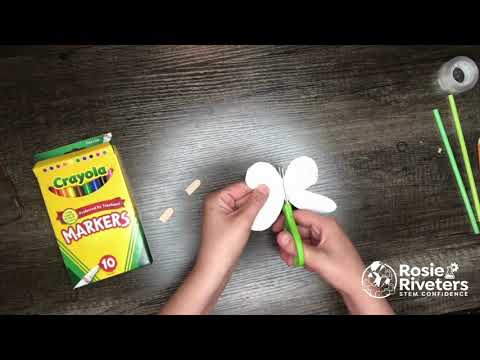
  • 6" hook nose propeller
  • jumbo popsicle/craft sticks
  • paper clip
  • rubber band
  • tape
  • scissors
  • index cards

Step-By-Step Instructions

Step 1

Take a craft sick and hook it into one of the 6” hook nose propellers

Step 2

Bend a paperclip until it is open by pulling the center outward to create a “v” shape

Step 3

Place one side of the paper clip below the end of the craft stick (on the end that is not connected to the propeller) and use a piece of tape to secure it

Step 4

Use the example shape to design your helicopter on an index card. You’ll want your design to be about 1.5 inches x 7 inches.

Experiment tip: the size and shape of your helicopter will impact the drag. If it is too small, you may not have enough lateral drag and too much energy will be pushed onto the craft stick. If it is too big and your helicopter may be too heavy to lift. Your students can experiment on their own with these adjustments and discover how changes will impact the helicopters’ flight. If you want a greater chance of a successful first flight to start out, try the example design included in this lesson, then for future experiments they can design their own.

Step 5

Tape the helicopter cut out to the craft stick on the side opposite of the hook.

Step 6

Take a rubber band and stretch it over the propeller hook and the paper clip (you
can attach additional rubber bands if needed)

Step 7

To fly the helicopter, spin the propeller to twist the rubber bands (the number of turns your helicopter makes will depend on the number of times you twist the rubber band).

Experiment tip: Twisting the rubber band until it is completely coiled and then doubles over to completely coil again should do the trick.

Step 8

Once you have wound the rubber band, hold the top of the propeller and the bottom of the craft stick near the paper clip.

Step 9

Let go of the top first and then the bottom (within a second of each other) to make the helicopter fly!

Optional STEM Activities

Resource 1

Exploring Airfoils

Ask students to cut a strip of paper. Have them hold the paper between their thumb and forefinger. Then, have them take a deep breath and blow over the paper.

What happened when you blew air over the strip of paper?  The paper will actually lift up. When you blow air over the top of the
paper, your air molecules have to squeeze between the paper and the air above it. As a result, your air molecules speed up and loses pressure. This means that the pressure on the top of the piece of paper was lower than on the bottom, creating lift!

Check out this video of a hairdryer and an airfoil. The same scientific phenomenon is happening here, and this is also how helicopters and planes get lift!

Resource 2

Whirlybirds

Cut out this Whirly Bird template and fold along the dashed lines. Once the whirlybird has been made, find an elevated place from which to drop them. Have one student with a stopwatch time how long it takes the whirlybird to touch the ground. Record that number. Then, have the students add paper clips one at a time and record how long it takes the whirlybird to reach the ground each time. Explain to the students that each paper clip represents additional drag. If you would like, you can have students run three trials per paperclip (for up to four paperclips in total) and average the
data to get a more accurate assessment of time.

Assessing their data, have students discuss what happened when they increased the drag on our whirlybirds? How could they counter-act the drag? (having a motor!)

Resource 3

Check out this Rosie Makes video on the Four Forces of Flight!