 Grade
Grade  Print this resource
- Step-by-step instructions and teacher’s visual build guide of the Rosie Riveters’ Simple Machines project,
- Classroom Resources: Knot Tying Guide, Class Lesson Slides, Spanish – Read Aloud Instructions , Student Build Guide,
Time: 30 to 40 minutes (build plus experimentation)
Big idea: Simple machines change the size or direction of a force to make work easier. Students build a pulley wall, then reroute the string to discover what a pulley actually does.
Standards Snapshot: Virginia SOL + NGSS
Pick your grade band. The build is the same, the thinking changes.
| Grade | Virginia SOL | NGSS | Students walk away able to… |
|---|---|---|---|
| K | K.2: pushes and pulls affect the motion of objects | K-PS2-1 · K-PS2-2 | Show that pulling the string down makes the cup go up, and compare gentle and strong pulls. |
| 1 | 1.2: forces change the speed and direction an object moves | — | Describe the cup’s motion and name the pull that causes it. |
| 3 | 3.2: simple machines increase or change the direction of force; friction opposes motion (primary fit) | 3-PS2-1 · 3-5-ETS1-2, ETS1-3 | Explain that the pulley changes the direction of their force, and test which string route works best. |
| 5 | 5.2: direct and indirect forces affect the motion of objects; energy and motion | — | Explain why a heavier cup is harder to lift, using friction and force in the explanation. |
| K–5 | X.1: Scientific and Engineering Practices | ETS1 (Engineering Design) | Predict, test a design, compare routes, and improve the build based on results. |
Practices exercised (both frameworks): asking questions and predicting · planning and carrying out investigations · comparing designs and interpreting results · constructing explanations from evidence. NGSS Crosscutting Concept: Cause and Effect · Structure and Function.
Curiosity & Wonder
Do not define simple machines yet. Wonder out loud with your students:
“Construction workers lift steel beams way up into the sky. Elevators lift people fifty floors. Nobody is strong enough to do that with just their arms. So how do you think they do it?”
Take guesses. Then: “Thousands of years ago, people invented six tools so clever we still use them every single day. Today we are building one of them.”
Quick tour of the six: lever (seesaw), wheel and axle (doorknob), inclined plane (ramp), wedge (knife), screw (jar lid), and pulley, which is ours today.
The Build
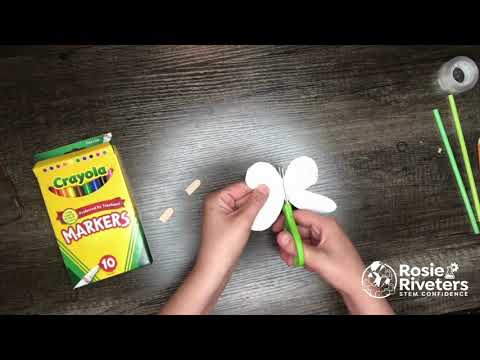
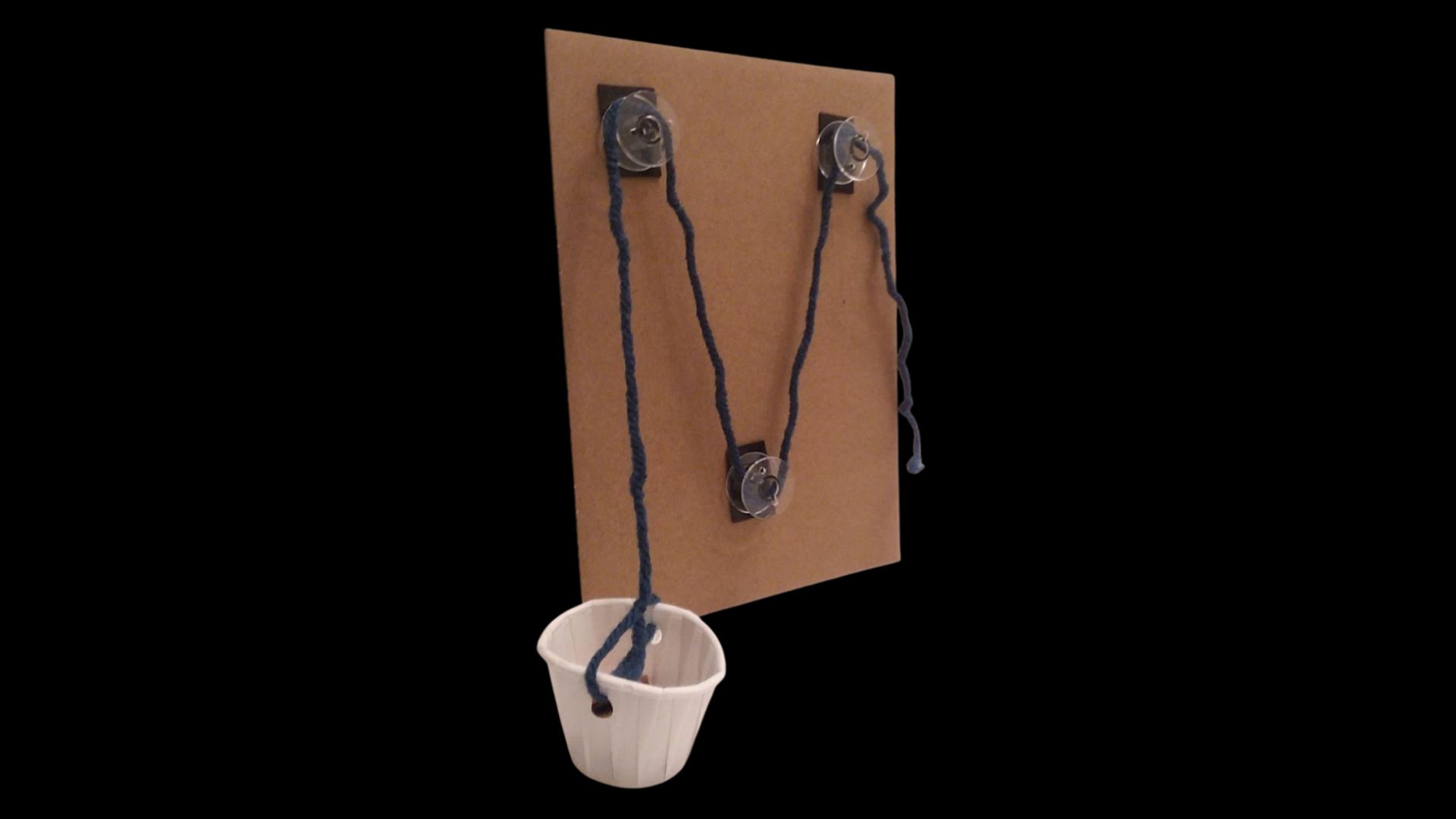
Materials per student: cardboard, easel, self-adhesive strips, double-sided tape, 3 bobbins, mini cup, string, pennies or weights, hole punch.
- Attach the cardboard to the easel using the self-adhesive strips.
- Stick three pieces of double-sided tape to the cardboard in an upside-down triangle.
- Press the flat side of one bobbin onto each piece of tape.
- Punch a hole in each side of the mini cup, run the string through, and tie it off just above the cup to make a handle.
- Route the string through the bobbins, starting at the far left: over, under, over.
- Add pennies to the cup and pull gently on the free end of the string to lift it.
Productive struggle moments
Our STEM projects are designed so that participants get it wrong before they get it right. You will observe your students struggling as they attempt to create their own STEM projects. This process is an empowering experience, building perseverance, frustration tolerance, and growing overall confidence! With your support, students will step out of their comfort zones to think, build, and problem-solve for themselves.
- Peeling double-sided tape tests fingernail patience. Suggest folding a corner first, then step back.
- Tying the knot to the cup (see Knot Tying Guide) may take three tries. Three tries is the point.
- The over-under-over route is easy to get backwards, and a wrong route often still works, just differently. That is not an error to fix. It is data for the investigation below.
When frustration shows up, narrate instead of fixing: “You are doing the hard part right now. What is one thing you could try differently?”
The Investigation
The original step 7 is the whole lesson: reroute the string and see what changes. Structure it:
Predict: “If I route the string ___, then the cup will ___ because ___.” Test at least two routes: over-under-over versus over-over-over, or two bobbins versus three. Pull from different directions: down, sideways, at an angle. Measure (grade 3+): how many pennies can each route lift before the pull feels hard? Pennies are a built-in measurement unit. Explain the mechanism (grade-band it):
- K–1: I pull the string down, and the cup goes up. The pulley flips my pull around.
- 3: A pulley changes the direction of a force. Pulling down is easier for our bodies than lifting up, so the machine makes the job easier even though the cup weighs the same.
- 4: More pennies means more weight pressing the string against the bobbins, which means more friction. That is why a full cup is harder to lift even with the pulley helping.
Honest physics note for teachers: a fixed pulley like this one changes the direction of the force rather than shrinking it. The win is that pulling down (using your body weight and gravity) beats hauling up. Avoid telling students the pulley makes the cup “lighter.” Let them discover what it actually does, then name it.
Great “failure” to expect: some routes will jam, or the cup will tip and spill weight. Ask: “Where is the string getting stuck? What could you change about your route?” Jammed pulleys are friction made visible.
Skills in Practice
- “I predict this route will ___ because ___.”
- “I observed the cup ___ when I pulled ___.”
- “My evidence shows the pulley changes ___.”
- “Next time I would route the string ___ because ___.”
Real-World Connection
Flagpoles, blinds, cranes, elevators, rock-climbing gear, and stage curtains all run on pulleys. Ask: “Where could a pulley help you at home?” (Lifting a basket to a bunk bed, raising a bird feeder, hauling toys upstairs.) For grade 3+, connect to compound machines: a crane is a pulley plus a lever plus a wheel and axle, all working together.
Evidence of Learning
- K–1: Student demonstrates the pulley and states “I pull down, the cup goes up.”
- 3: Student names what the pulley changed (the direction of the force) and which of their routes worked best, in one or two sentences.
- 4: Student explains in 2 to 3 sentences why more pennies made lifting harder, using the words force and friction.
Vocabulary
- simple machine: a tool that changes the size or direction of a force to make work easier.
- pulley: a wheel with a rope or string around it that changes the direction of a pull.
- force: a push or a pull.
- friction (grades 3+): a force that resists motion when surfaces rub, like the string against the bobbins.