 Grade
Grade  Print this resource
In this Rosie Labs guide you will find:
- Lesson objectives and concept overview,
- Optional STEM topic video to share with participants,
- Step-by-step instructions and video of the Rosie Riveters’ Water Cycle Bottles project,
- Optional STEM activities to further explore the objectives and concepts used in the project build.
Objective
Students will learn the components of the water cycle and how water moves through each step of the process.
Concept Overview and Experiment Inspiration
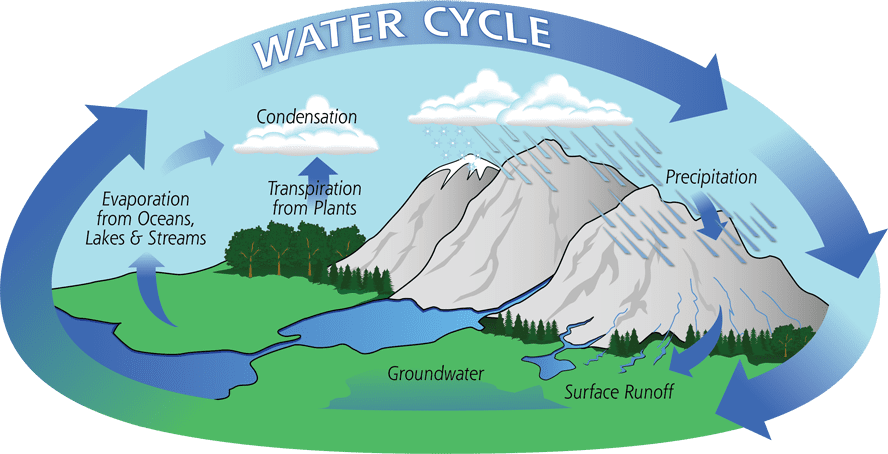
The water cycle, also known more technically as the hydrological cycle, describes how water evaporates from the surface of the earth, can rise up into our atmosphere, and then cool down turning back into rain and falling down again to the surface of the earth (see Figure 1).
We can begin understanding the water cycle with first looking at pools of water sitting on the earths’ surface. These can be as small as puddles of water in your backyard after it rains or larger bodies of water such as lakes, rivers, and oceans.
Pools of water on the earth’s surface are in their liquid state. When the earth warms, usually from the heat of the sun, water turns from a liquid into a gas. This process is known as evaporation and the gas that results from evaporation is known as water vapor. At the same time that water on the surface of the earth turns into vapor, plants are also losing water into the
atmosphere; a process known as transpiration. Water from evaporation and transpiration rises and makes its way up into the atmosphere, where it will cool down since the higher you travel in our atmosphere the colder it gets. Water cooling down turns from a gas into a liquid in a process known as condensation. This process causes the formation of clouds in the sky.
Clouds are masses of tiny water droplets that have cooled in the air. When these water droplets become too large and heavy they fall back to the earth. The falling droplets is called precipitation. Depending on the temperature of the atmosphere, precipitation can be rain, snow, sleet or hail.
As water falls back down to earth, it will be collected in the previously described bodies of water in a variety of ways. It can fall directly into an already existing body on the surface of the Earth. It can also land on vegetation, where it will either pool or trickle down into the ground, before being absorbed by the roots of plants. Water that falls directly onto land can move across the
ground until it ultimately collects into oceans, rivers or lakes. And then the cycle continues!
One important note, if the outside temperature near the surface of the earth is extremely cold, water can build up on land in the form of ice or glaciers. This water will stay on the surface of the earth in a solid state until it begins to warm again, restarting the entire cycle.
Science Goals
- The water cycle, or the hydrological cycle, is the constant, natural cycle of water evaporating, condensing and returning back to Earth.
- Water is matter that exists in three states; solid, liquid and gas.
- The water cycle is important because it enables the availability of water to the Earth and regulates weather patterns.
Vocabulary
- water cycle – also known as the hydrological cycle, is the constant, natural cycle of water evaporating, condensing and returning back to Earth.
- evaporation – to change from a liquid state to a gas or vapor.
- condensation – to change from a gas or a vapor into a liquid state
- precipitation – water released from clouds in the form of rain, snow, sleet or hail.