 Print this resource
Welcome to the Rosie Riveters’ Biomechanical Hands Project! This guide is designed to help you introduce students to the fascinating world of biomechanics through a hands-on activity where they will build a model of a human hand. The project aims to give students a deeper understanding of the muscular and skeletal systems and how they work together to create movement.
How This Guide is Structured:
Teacher Script for Students:
- This section provides a ready-to-use script that explains the scientific concepts behind the activity. It introduces key ideas about how muscles, tendons, and bones interact to produce movement. Feel free to read it directly to your students or adapt it to fit your teaching style.
Key Concepts and Learning Goals:
- The activity focuses on helping students understand how the muscular and skeletal systems function together. They will learn how tendons act like strings to transfer the force from muscles to bones, and how these parts collaborate to create precise hand movements. Students will also engage in design thinking, exploring how engineers use similar principles to develop prosthetic limbs and robotics.
Hands-On Building and Experimentation:
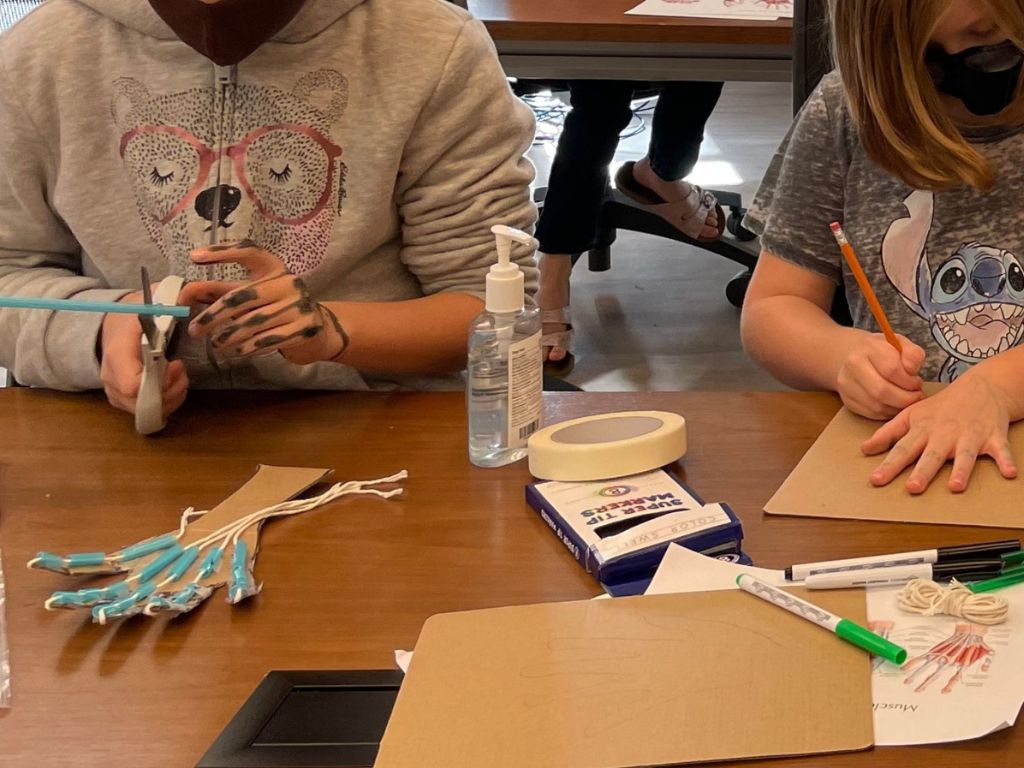
- Students will use simple materials (e.g., straws, string, cardboard) to create a model of a hand that demonstrates how tendons and bones work. The building process encourages them to think critically and experiment with different designs, helping them understand the mechanics of movement.
- Encourage students to make adjustments, test different configurations, and see how their changes affect the model’s movement. This fosters creativity, problem-solving, and a deeper understanding of biomechanics.
Discussion and Reflection:
- After the building phase, use the reflection prompts to guide a discussion with your students. This helps them connect what they’ve built to real-world applications and solidify their understanding of how the body’s systems work.
- Encourage students to think about how their model compares to a real hand and how similar concepts are used in technology and engineering.
Wrap-Up and Real-World Connections:
- The project concludes with a wrap-up session that ties everything back to broader applications, like prosthetic design and robotics, emphasizing how learning about biomechanics can lead to solving real-world problems.
Teacher Script for Students
Our hands are an incredible example of how different parts of our body work together. Inside your hand, there are bones, muscles, and tendons, and each part has a specific role:
- Bones give structure and support, acting as a solid frame for movement.
- Muscles provide the power to move by contracting and pulling on tendons.
- Tendons are like strings that connect muscles to bones, transferring the pull of the muscles to make the bones move.
When you want to move your hand, your muscles contract (tighten up) and pull on the tendons. The tendons then pull on your bones, making your fingers move. It’s a well-coordinated system that gives you the ability to grip, point, and make precise movements.
Building the Biomechanical Model:
Today, you’ll be building a model that mimics this process:
- Straws or cardboard will represent the bones of your hand, providing structure.
- Strings will act as the tendons, connecting and pulling the “bones” to make them move.
- Your hand movements will mimic how muscles contract to pull the tendons and move the fingers.
When you pull on the strings, your model hand will bend and move, just like how your real tendons move your bones when your muscles contract. You’ll see how each part of the system works together, just like in your own hand!
Muscles and Tendons Working Together
The muscular and skeletal systems are essential for movement. Every time you grab something, write, or wave, your muscles and tendons are working together to make it happen. With your model, you’ll see how pulling on the “tendons” (strings) moves the “bones” (straws), similar to how your real muscles and tendons work.
Experimentation and Design Thinking
As you build your model, you’ll get to experiment and think creatively. Want the fingers on your model to move more smoothly? Try changing the placement of the “tendons” or adjusting the design. Engineers do the same thing when they design prosthetic limbs or robotic hands that need to mimic natural hand movements.
Why It Matters
Understanding how your body’s systems work together helps scientists and engineers create devices for people who need assistance with movement. From prosthetic hands to robots that can perform delicate tasks, the principles you’re exploring today are used to solve real-world challenges.
Wrap-Up:
As you build and test your biomechanical hand, think about the roles of each part:
- How do the “muscles” and “tendons” work together to move the “bones”?
- What happens when you change the way they’re connected?
- How does this compare to how your actual hand works?
By the end of this project, you’ll have a better understanding of how the muscular and skeletal systems interact to create movement. This knowledge is not only important for science, but it’s also the basis for designing technologies that improve lives. Who knows? Maybe you’ll use what you’ve learned to design the next innovative prosthetic hand or robotic arm!