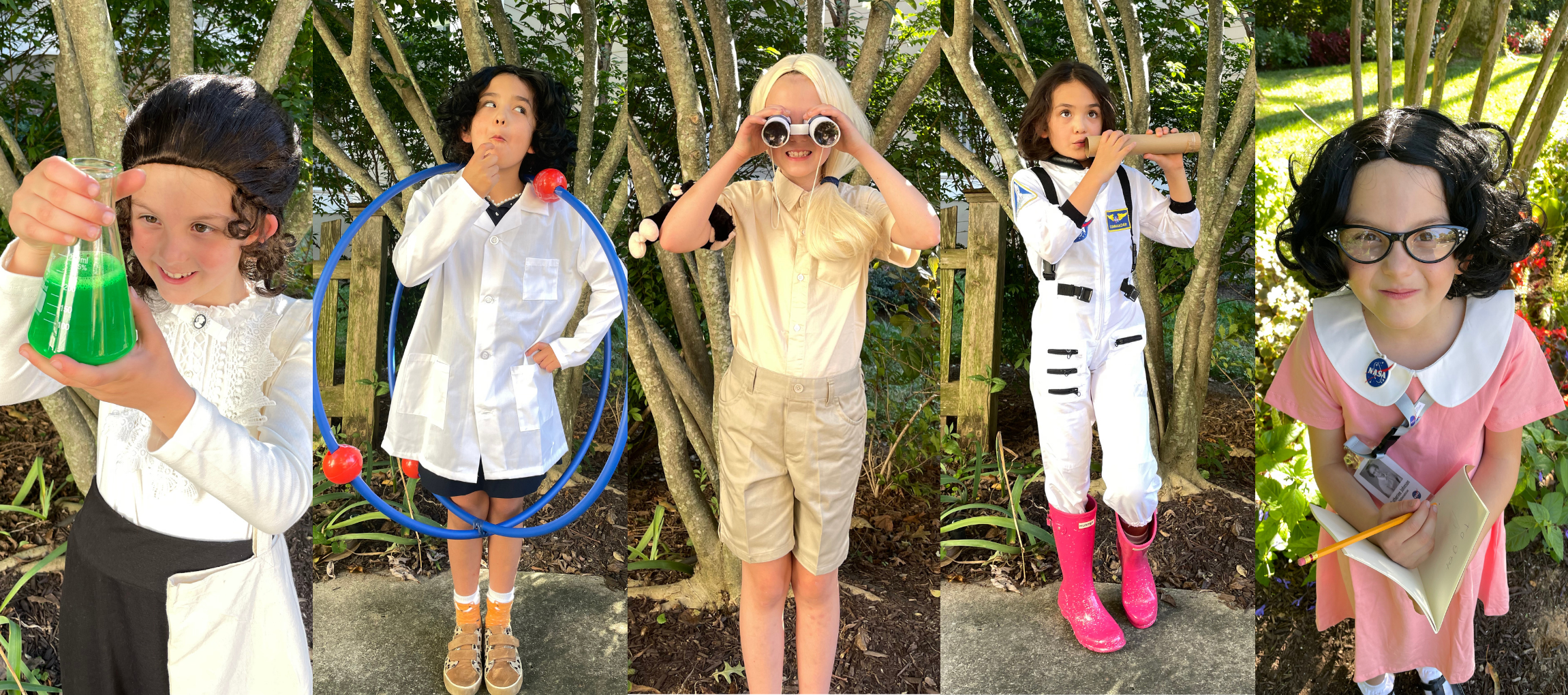
The mantra we repeat in our programs is “I may not know, but I know I can figure it out.” Our projects are designed to foster the same “we can do it” attitude, and we encourage you to share this message with your children at home.

3rd-5th Grade Projects

Resource 1

Lava Lamps

Below are some key terms and definitions we covered today regarding chemical reactions. 

Physical Change: In a physical change there can be a difference in the appearance, smell, or simple display of a sample of matter without a change in composition. We explored this by folding paper (origami balloons) to observe that although the paper looked different it was still paper. 

Chemical Change: In a chemical change a new substance is formed and energy is either given off or absorbed. We explored chemical changes by creating erupting lemons. We pushed baking soda into a lemon and watched it bubble and fizz. What is actually happening: the citric acid from the lemon juice is reacting to the base of the baking soda creating a gas called carbon dioxide. 

Chemical Reaction: Don’t be alarmed if your kids start waving their hands around when you ask them what a chemical reaction is. We used our hands to remember that a chemical reaction is when we mix two different things together to make something new.

 Here is a questions to ask your child about density:

Q: How do I tell if something has more molecules than something else? What is that called?

A: Weight (or mass) and density are proportional when objects are the same size because the more molecules, the heavier an object will be. So we can identify if something is denser (measure density) than something else by its weight (or mass).

Check out our Rosie Explores activity below to learn more!

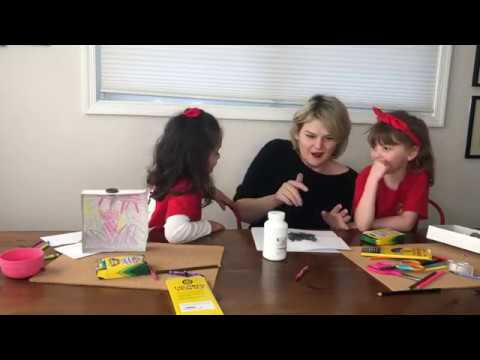
Adult and children explore hemical and Physical Change

Rosie Explores Chemical and Physical Change

Perform these fun experiments to explore chemical and physical change!

Resource 2

Art Bots

Here are a couple definitions, questions to get your kids talking about what they learned today, and a few additional things to note.

Definitions:

  • Electrons: A stable subatomic particle with a negative charge, found in all atoms and acting as the primary carrier of electricity in solids. We had a great time “repelling” (passing an extra ball around) them in our circuit.
  • Batteries:  When a battery is supplying electric power, its positive end (cathode) and its negative end (anode). The end marked negative (-) is the source of electrons that, when connected to an external circuit, will flow and deliver energy to an external device like an electric motor. We worked to make sure that the positive and negative ends of our batteries were positioned properly in our circuits.
  • Circuit: A circuit is a path that starts and stops at the same place. We talked a lot about circles today and how circuits have to be completely “closed” to work.

With this information in mind some, below are a few questions to ask your kids:

  1. What is electricity? Electricity is the flow of charge. Usually charges will be carried by free-flowing electrons. Elements with high conductivity, which have very mobile electrons, are called conductors. These are the types of materials we want to use to make wires and other components which aid in electron flow. Metals like copper, silver, and gold are usually our top choices for good conductors.
  2. What three things are required to create an electric circuit that makes their Art Bot run? An energy source (battery), a path (wire), and a motor.
  3. What would happen if one of the legs of the wires were to come loose from the circuit? The circuit would be open and the flow of electrons would stop moving through the circuit, meaning the motor would not run.

A couple of things to note:

  • If any part of the circuit becomes loose, the connection may become incomplete and the Art Bot will not turn on. The points of connection to check are:
    • Where the wires connect to the base of the motor.
    • Where the motor wires and the battery pack wires are connected.
  • As the motors on the Art Bots are constantly moving things can become loose and/or disconnected. If the art bot stops working the first places to check are the connection points outlined above.

Check out our Rosie Explores activity below to learn more!

Private: Rosie Explores Electricity

Have fun exploring electricity by making a closed circuit with your friends!

Resource 3

Metamorphosis Caterpillar Fans

Today we learned about metamorphosis, how DNA research is helping scientists understand patterns on butterfly wings, and about monarch butterfly migration.

We learned that insects are not the only creatures that go through metamorphosis and we also learned about the different stages of metamorphosis by playing go bug!

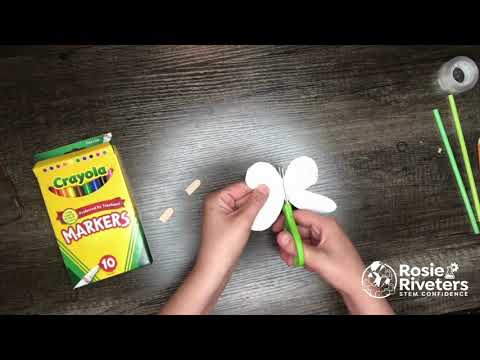
After learning some amazing facts about butterflies we built our own Metamorphosis Caterpillar Fans!

Some questions to ask your child about what they learned today:

  • What are the four stages of a butterfly’s metamorphosis? (egg, larva, pupa, adult)
  • How many miles do monarch butterflies migrate? (3,000!)

Check out our Rosie Explores activity below to learn more!

Butterflies and Metamorphosis young girl wearing butterfly wings next to a detailed image of a monarch butterfly

Rosie Explores Butterflies and Metamorphosis

Join Rosie Girl Veronica as she shares butterfly facts and outlines the four stages of metamorphosis!

Resource 4

Artificial Lungs

Explore your child’s project and pull on the balloon at the bottom. What happens? The balloon inside the cup should inflate as you pull down and then deflate as you let go. Why? As the knotted balloon is pulled it creates more space inside the bottle. Air can then come down the straw and fill the inside balloon which now has more space. When you let go, the balloon no longer has the space that it needs so the air goes back out through the straw and the balloon deflates. 

This is exactly like our lungs, where air is taken through the mouth and nose and passes into our lungs. The diaphragm at the bottom of our chest expands to create more space, pulling air into our lungs as we breathe in and then the diaphragm relaxes pushing it out again. The cut balloon represents the diaphragm and the balloon inside the container is our lungs.

Check out our Rosie Explores activity below to learn more!

digital x-ray image of the lungs

Rosie Explores the Lungs

Have fun exploring how lungs work, what vacuums are, and how they play an important role in respiration.

Resource 5

Film Canister Rockets

Today we explored the concepts of potential and kinetic energy by creating Film Canister Rockets. We had a great time exploring these fundamental physics principles in a hands-on and interactive way.

Potential energy is the stored energy in an object due to its position or state, while kinetic energy is the energy of an object in motion. As we launched our rockets, we were able to see how the potential energy stored in compressed air converted into kinetic energy in the form of motion.

Here are a few questions that you can ask your child to continue their learning at home:

  • What is potential energy?
  • What is kinetic energy?
  • How did the compressed air in the bottle become kinetic energy?
  • Can you think of any other examples of potential and kinetic energy in our daily life?

Check out our Rosie Explores activity below to learn more!

Potential and Kinetic Energy Girl Blowing up a purple balloon

Rosie Explores Potential and Kinetic Energy

Investigate potential and kinetic energy with two fun experiments!