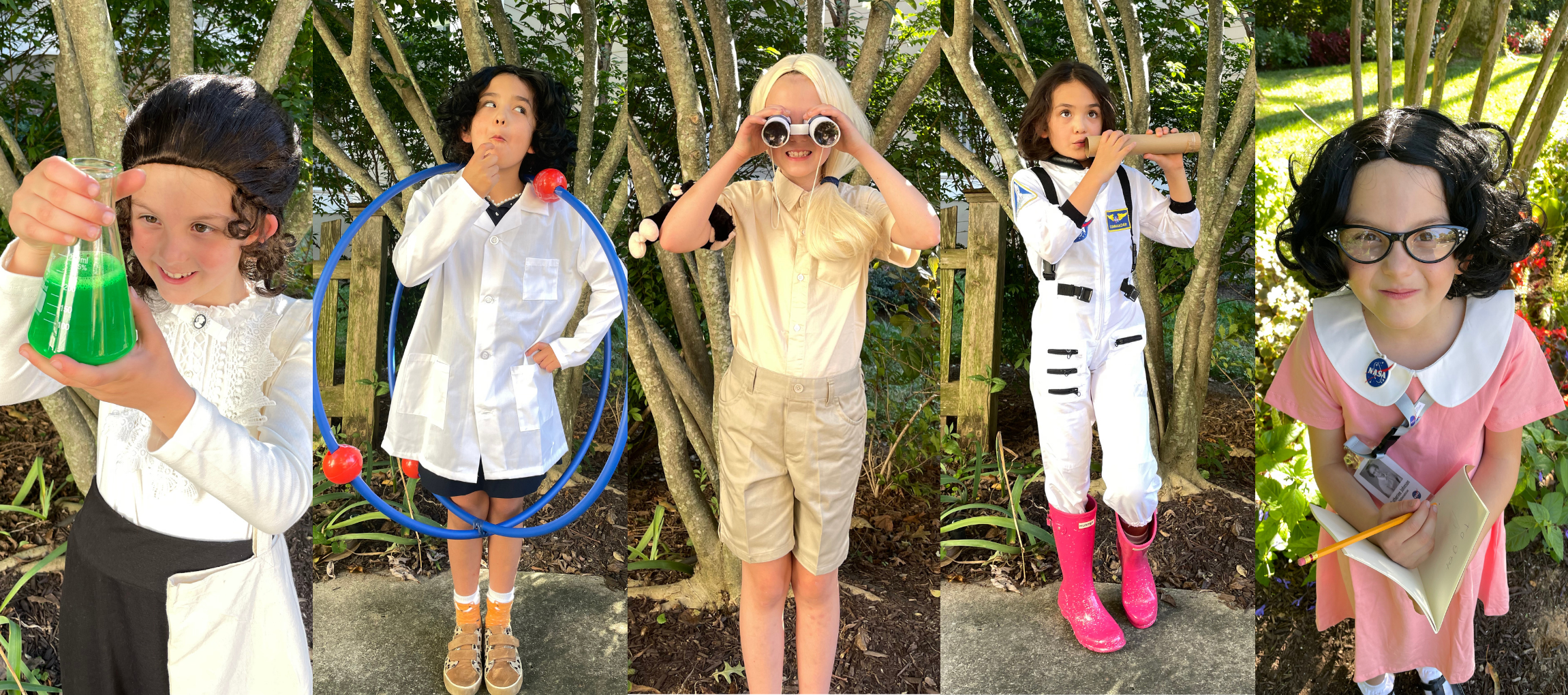
The mantra we repeat in our programs is “I may not know, but I know I can figure it out.” Our projects are designed to foster the same “we can do it” attitude, and we encourage you to share this message with your children at home.

K-2nd Grade Projects

Resource 1

Volcanoes

We encourage you to further explore the principles discussed in today’s project with your child in an effort to reinforce their understanding of the subject matter and inspire their continued curiosity of STEM. Below are some key terms and definitions we covered today regarding chemical reactions. 

Physical Change: In a physical change there can be a difference in the appearance, smell, or simple display of a sample of matter without a change in composition. 

Chemical Change: In a chemical change a new substance is formed and energy is either given off or absorbed. 

Chemical Reaction: Don’t be alarmed if your kids start waving their hands around when you ask them what a chemical reaction is. We used our hands to remember that a chemical reaction is when we mix two different things together to make something new.

A fun example of a chemical reaction is when you mix vinegar and baking soda in your child’s model volcano, creating a fizzing eruption. This reaction produces bubbles of CO2 gas because the acidic vinegar reacts with the basic baking soda. If your child would like to erupt their volcano at home again all you need is a tsp of baking soda and some vinegar. You can add food coloring and glitter as well. 

Check out our Rosie Explores activity below to learn more!

Adult and children explore hemical and Physical Change

Rosie Explores Chemical and Physical Change

Perform these fun experiments to explore chemical and physical change!

Resource 2

Flying Magnetic Art

Today we explored magnets by experimenting with what would and would not stick to a variety of different objects. We discovered that magnets are attracted to special metals (typically metals with iron in them).

Your child’s flying magnetic art project includes a metal paper clip (a magnetic object) that is attracted (pulled toward) the magnet at the top of their box. Because the magnet’s field is bigger than the magnet itself, we were able to put the paperclip on the outer edge of the magnet’s magnetic field (using the fishing line)so that the paperclip looks like it is flying!

Check out our Rosie Explores activity below to learn more!

Rosie Explores Magnetism

Try this fun experiment to learn about the science of magnets!

Resource 3

Static Electric Dancers

We first examined static electricity by exploring atoms. Atoms are made up of three types of particles called protons (+), neutrons and electrons (-). By playing with magnets we were able to relate how these particles interact with each other. (+,+ or -,-) repel each other (push away) and opposite particles (+,-) attract each other (come together). 

We then discussed places where we have seen or felt static electricity like if you’ve ever gotten a “shock” while walking or running in your socks or watched someone’s hair fly up in the air when it’s rubbed against a balloon! The rubbing between those two objects (eg. socks & floor or hair & balloon) causes some of the electrons in an atom to break away. But Atom’s like to be balanced. So if an electron is floating free in the world it will look for a proton to ATTRACT to!

We used this powerful attraction between protons and electrons to make our tissue paper creations dance and fly! 

Check out our Rosie Explores activity below to learn more!

Static Electricity experiments

Rosie Explores Static Electricity

Have fun exploring the power of static electricity by moving a can without your hands!

Resource 4

Pom Pom Propulsion

Today we explored how forces, like propulsion, can be used to engineer a pom pom propeller that sends pom poms flying across the room!

Propulsion is a force that pushes or drives an object forward. When an object is pushed both forwards and upwards at the same time, we have what is known as a propulsion system. A great example of something that uses a propulsion system is an airplane! The jets of an airplane produce a gas known as exhaust which, when forced out the back of the plane by the engine, propels (pushes) the airplane forward.

Some questions to ask your kids include: 

  • What is propelling the pom poms out of the paper tube? 
  • How can they make the pom poms travel a shorter or longer distance? 

Check out our Rosie Explores activity below to learn more!

propulsion

Rosie Explores Propulsion

Have fun exploring propulsion as we learn about Newton's third law!