The mantra we repeat in our programs is “I may not know, but I know I can figure it out.” Our projects are designed to foster the same “we can do it” attitude, and we encourage you to share this message with your children at home.
K-2nd Grade Projects

Resource 1

Density Bracelets

Today your child learned about mass and density through the creation of tubular science bracelets where glitter and perler beads serve as literal illustrations of these principles. We encourage you to further explore the principles discussed in today’s project with your child in an effort to reinforce their understanding of the subject matter and inspire their continued curiosity of STEM.

Below are some questions that you might like to explore with your child:

Q: How do I tell if something has more molecules than something else? What is that called?

A: Weight (or mass) and density are proportional when objects are the same size because the more molecules, the heavier an object will be. So we can identify if something is denser (measure density) than something else by its weight (or mass).

Q: Why don’t the perler beads in your bracelet float freely like the glitter does?

A: The beads have a higher density than water, so they sink and won’t move freely around the tube. The density of the glitter is less than that of water, so it floats around the tube.

Check out our Rosie Explores activity below to learn more!

Density

Rosie Explores Density

Join us as we make hypotheses about which objects will sink or float!

Resource 2

LED Art

Definitions:

  • Electrons: A stable subatomic particle with a negative charge, found in all atoms and acting as the primary carrier of electricity in solids. We had a great time “repelling” (passing an extra ball around) them in our circuit.
  • Batteries:  When a battery is supplying electric power, its positive end (cathode) and its negative end (anode). The end marked negative (-) is the source of electrons that, when connected to an external circuit, will flow and deliver energy to an external device like an electric motor. We worked to make sure that the positive and negative ends of our batteries were positioned properly in our circuits.
  • Circuit: A circuit is a path that starts and stops at the same place. We talked a lot about circles today and how circuits have to be completely “closed” to work.

With this information in mind some, below are a few questions to ask your kids:

  1. What is electricity? Electricity is the flow of charge. Usually charges will be carried by free-flowing electrons. Elements with high conductivity, which have very mobile electrons, are called conductors. These are the types of materials we want to use to make wires and other components which aid in electron flow. Metals like copper, silver, and gold are usually our top choices for good conductors.
  2. What three things are required to create an electric circuit that makes their LED turn on? An energy source (battery), a path (wire), and a motor.
  3. What would happen if one of the wires were to come loose from the circuit? The circuit would be open and the flow of electrons would stop moving through the circuit, meaning the light would not turn on.

Check out our Rosie Explores activity below to learn more!

Private: Rosie Explores Electricity

Have fun exploring electricity by making a closed circuit with your friends!

Resource 3

Balloon Powered Cars

In this project, we converted potential energy (air inside the balloon) into kinetic energy (motion of the car) as they released the air and watched their cars roll forward. This hands-on experience helped them understand the basic principles of energy conversion in a fun and engaging way.

To continue this exploration of energy at home, I would encourage you to ask your child the following questions:

  • How does the air inside the balloon help power the car?
  • Can you explain potential and kinetic energy in your own words?
  • What other ways can potential energy be converted into kinetic energy? (e.g. a roller coaster, a bouncing ball, etc.)

Check out our Rosie Explores activity below to learn more!

Potential and Kinetic Energy Girl Blowing up a purple balloon

Rosie Explores Potential and Kinetic Energy

Investigate potential and kinetic energy with two fun experiments!

Resource 4

Bird Feeders

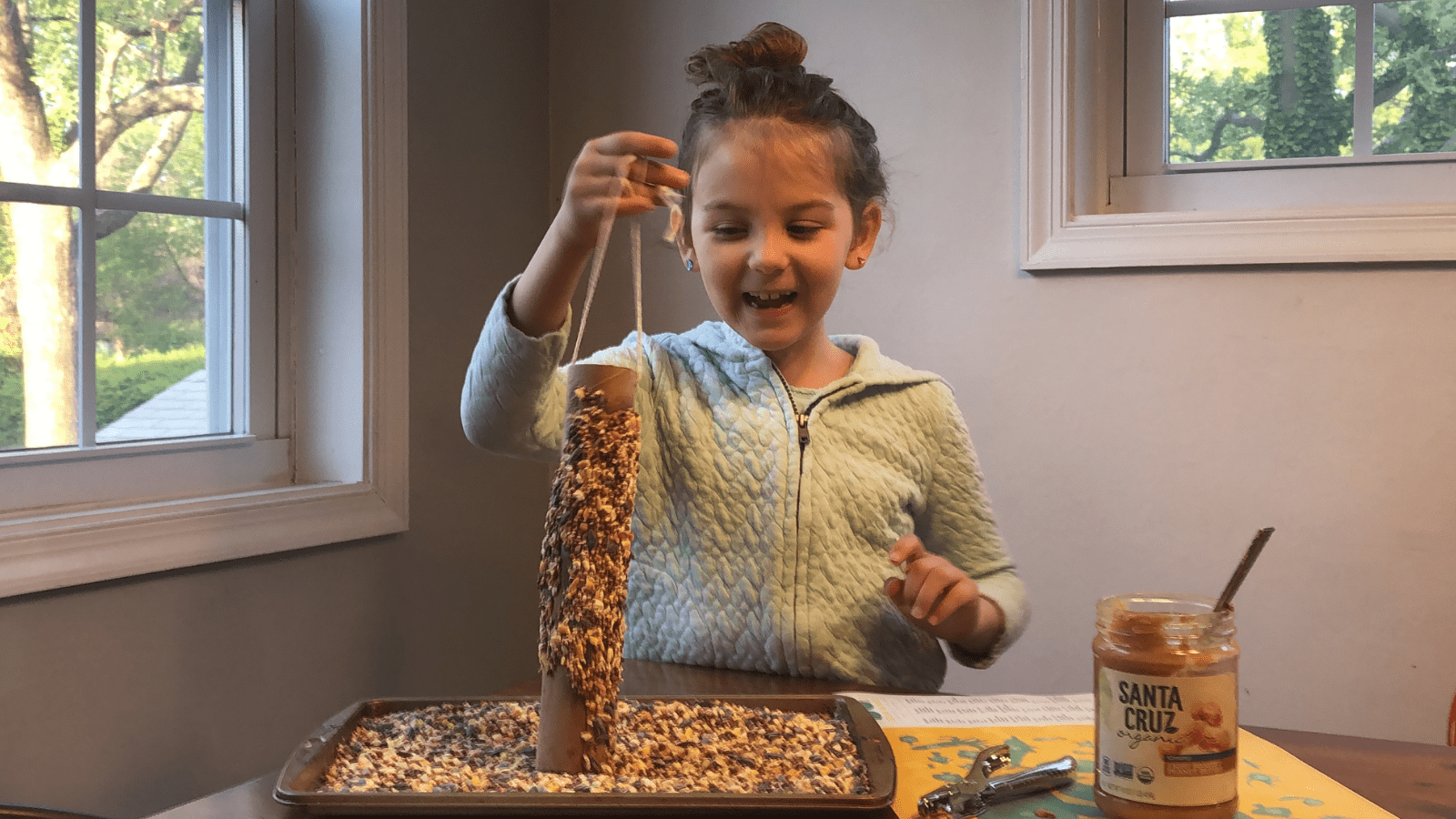
In this project, we created a bird feeder to change the habitat of birds and make it more inviting.

To continue this exploration of habitats at home, we would encourage you to ask your child the following questions:

  • Can you identify an animal habitat around you? What animal lives there and how has the animal adapted to meet its needs?
  • What are the four things a habitat needs? (food, water, shelter from weather and predators, and a place to raise their young).

Check out our Rosie Explores activity below to learn more!

Habitats sign posted in a meadow that reads "habitat restoration in progress"

Rosie Explores Habitats

Have fun learning about different types of habitats and how they're adapted to meet specific needs!