Grade
Grade  Print this resource
In this Rosie Labs guide you will find:
- Productive struggle opportunities for students during their project build,
- Lesson objectives and concept overview,
- Optional STEM topic video to share with participants,
- Step-by-step instructions and video of the Rosie Riveters’ Biomechanical Hands Project,
- Optional STEM activities to further explore the objectives and concepts used in the project build.
Objective
Students are introduced to biomechanics by exploring the relationship between how the muscles, tendons, and bones interact to make our body move.
Concept Overview and Experiment Inspiration
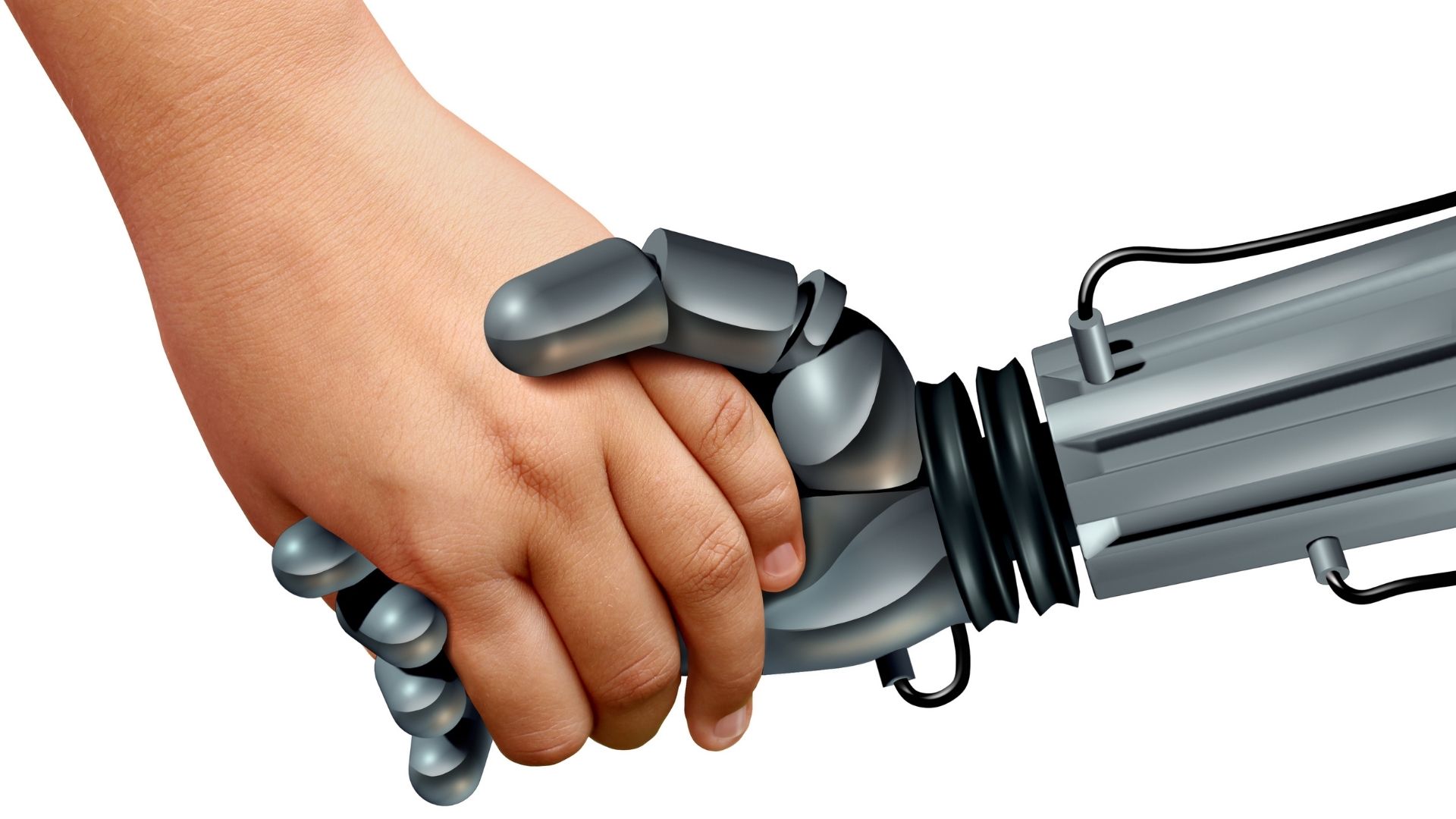
The field of study that investigates how our bodies and all living organisms work is called biomechanics. By studying biomechanics, scientists can use their knowledge of the body to tackle problems around us. We can better explore and test otherwise dangerous things such as car crash testing, manufacturing safety and even disaster relief by replicating the human body in the form of a robot. Robots provide the human-like skill and movement to perform tasks so that scientists get a better understanding of something before having actual humans participate.
A skeleton of a living organism includes all of the bones and joints in the body. Each bone is a complex living organ that is made up of many cells, protein fibers, and minerals. The skeleton acts as a scaffold by providing support and protection for the soft tissues that make up the rest of the body. The skeleton is also flexible with the help of joints, which is the place where two bones meet. The muscular system is responsible for the movement of the human body. Muscles pull on joints to assist with their flexibility and strength. Tendons attach muscles to the skeleton. Combined together this body system is called the musculoskeletal system.
The human hand is a complex, intricate, and fascinating combination of muscles, skin and bone. Its integrity is absolutely essential for our everyday functional living. In our hand alone there are twenty-seven bones that are connected by joints that can move and rotate!
In this project we are going to act like biomechanical engineers by examining the hand and how it moves!
Science Goals
- Biomechanics is a multidisciplinary study that applies science and technology to the mechanics of living things
- The human body has complicated systems that help make it function. The musculoskeletal system is a complex, intricate combination of muscles, skin and bone that are coordinated to make the body move.
Vocabulary
Biomechanics – the study of the movement and function of a living organism.
Musculoskeletal System – The internal framework of the body that gives the body shape and allows for movement