 Grade
Grade  Print this resource
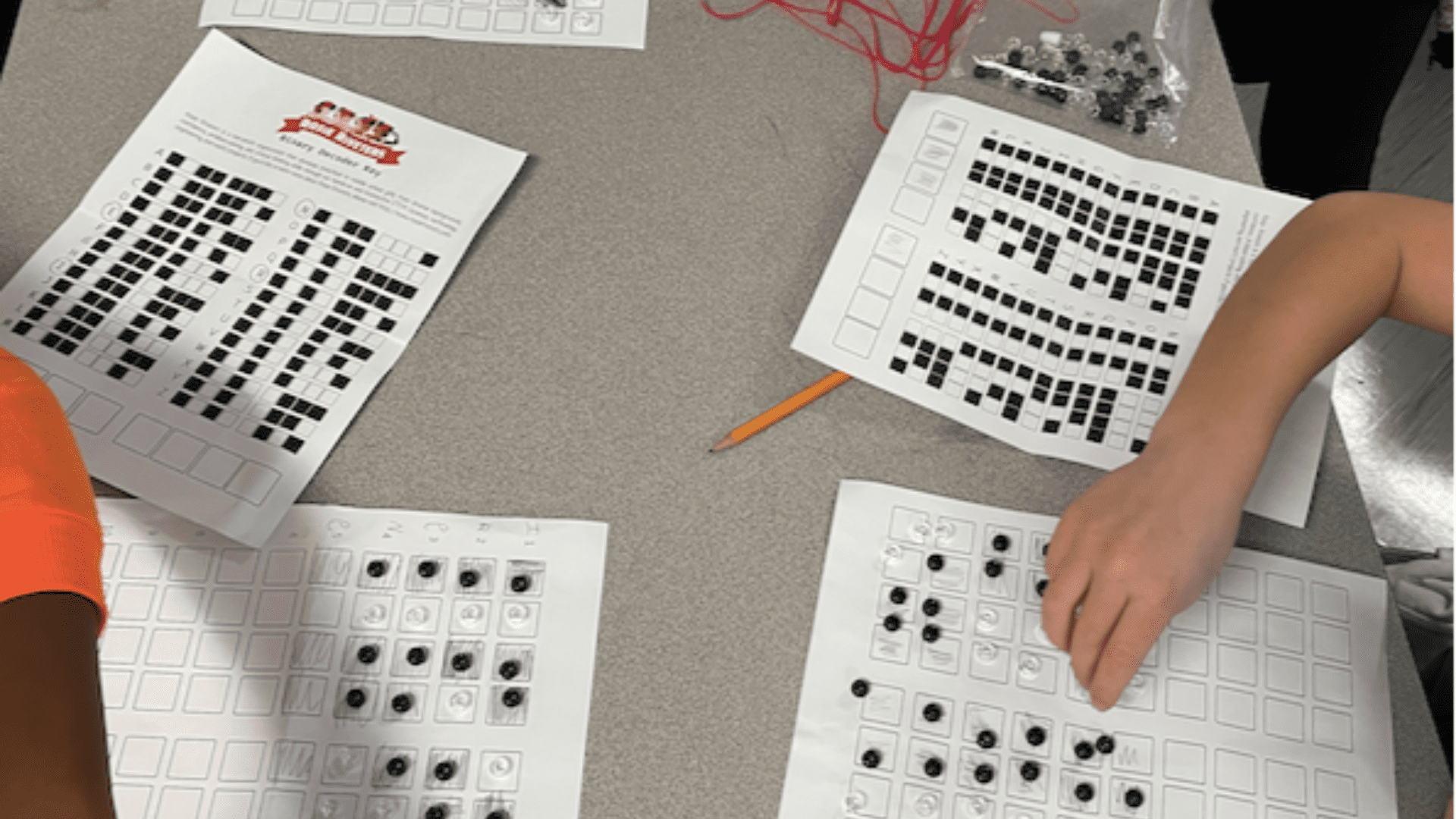
Every photo, video game, and text message starts as patterns of 1s and 0s called binary code. In this hands-on STEM activity, kids become computer scientists as they translate their names into binary and turn that code into a unique bracelet or necklace. Along the way, they’ll discover how computers store information while practicing pattern recognition and computational thinking.
Download the Binary Decoder Worksheet!
Why does binary work?
Computers only need two states:
- ON
- OFF
These are represented as:
- 1 = On
- 0 = Off
Every letter, number, emoji, and picture on your computer is stored using millions (or billions!) of these tiny on/off signals.
Each letter has a unique 8-bit binary pattern. For example:
A = 01000001
When you string beads in that pattern, you’re literally wearing computer code.
How Is Binary Used in the Real World?
You interact with binary every single day, even if you cannot see it.
Computers do not understand letters or words the way people do. Instead, they use patterns of 0s and 1s to represent information. Every app you open, every website you visit, and every photo you take is stored using binary code.
The bracelet you just made uses the same basic idea that powers today’s technology.
Binary is used in:
📱 Smartphones for texting, taking photos, and running apps
🎮 Video games for saving progress and controlling characters
🤖 Robots for following instructions and completing tasks
🚀 Space exploration for sending information between spacecraft and Earth
💻 Computers and websites for storing and sharing information
🎵 Music and streaming services for playing songs and videos
Every time you use technology, binary is working behind the scenes.